Nobody actually freezes at the naked part. That gets written about so much in English that most people turn up already braced for it, and then it’s over in about ninety seconds and turns out to be fine.
What goes wrong is smaller and stupider than that. You’re two steps inside the door holding your shoes, there’s a wall of little wooden lockers on one side and a counter on the other, and you cannot tell whether you’re supposed to pay first or stash your shoes first. Someone is waiting behind you. That’s the moment people describe to me afterwards — not the bath.
Most jjimjilbang guides for foreigners spend their word count on atmosphere: the heat, the eggs, the sweet rice drink, how restorative the whole thing is. All true. But what you need on a first visit isn’t a mood, it’s an order of operations. So here it is as an order. Nine steps, and I’ve put extra weight on the last two, because that’s where the confusion actually lands.
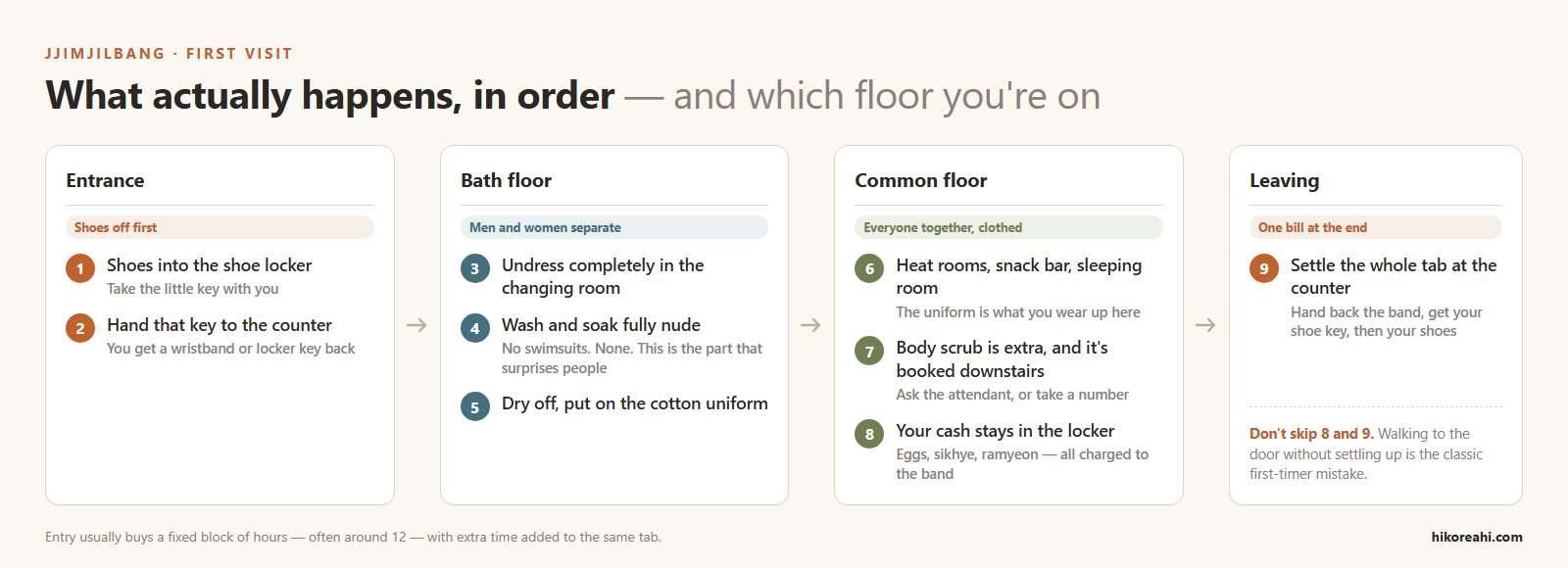
Steps 1–2: Shoes first, then the counter
The shoe lockers sit right inside the entrance, before you’ve spoken to anyone. Shoes off there, into an empty one, turn the key, keep the key.
Then you walk to the counter and hand that key over. This feels wrong the first time — you’re giving a stranger the key to your own shoes — but it’s the whole system in miniature. Your shoe key is collateral. In exchange you get a wristband with a locker number on it, or at smaller places a plain locker key on an elastic coil you wear around your wrist.
Pay attention to the number. You will not remember it in twenty minutes, in an aisle of four hundred identical metal doors, with your glasses fogged. I have walked the wrong row more times than I’d like to write down.
The counter is also where you find out what this costs, and I’d rather be straight with you than invent a number. There is no standard rate. Every place sets its own, nobody publishes a schedule, and the spread across the country is genuinely enormous — a large branded spa in Seoul can charge several times what a small neighbourhood bathhouse does for what is recognisably the same evening.
Two things do hold almost everywhere, and they’re more useful than a fake average. Weekday daytime is the cheap slot, and at an ordinary place it tends to land somewhere around the ₩10,000 mark. Late nights and weekends cost more in the same building — which matters a lot if the plan was to sleep there. The rate board is on the wall behind the counter, usually with the day and night prices in separate columns. Read it on the way in; it’s the only number that’s actually yours.
Steps 3–4: Downstairs, everything comes off
The bath comes before the sauna. Always, no exceptions, and the reason is practical rather than ceremonial — the common floor upstairs is shared by everyone, and the arrangement only works because every single person arrives up there already clean.
So: changing room, everything into the locker, then out onto the bath floor with nothing on. No swimsuit. No towel wrapped around you. Men and women are in entirely separate baths, usually on different floors, and this is the one part of the building where the split is absolute.
Wash properly at a shower station before you get into any pool. Sit on the little plastic stool, use the handheld shower, actually scrub. This isn’t the polite suggestion it is at a hotel pool. Climbing into a shared tub unwashed is the one thing that will genuinely irritate people, and it’s the only rule here I’d call non-negotiable.
Shampoo and body wash are usually mounted on the wall at each station. Usually. Some places skip it and sell little packets at the counter instead, so glance at the wall before you get committed.
Tattoos, briefly
There’s no law. Nothing in Korea bans tattooed people from a bathhouse. What exists is individual house policy, left over from a time when tattoos meant organised crime rather than a holiday in Bali.
In practice the big places in tourist districts stopped caring years ago and you’ll see plenty of ink in the water. Small old neighbourhood bathhouses sometimes still have a notice up. If you’ve got significant work and you’d rather not find out the hard way, ask at the counter before you pay. It takes two seconds and nobody is embarrassed by the question.
Steps 5–6: The uniform changes what the building is
After the bath you dry off and put on the cotton set that came with your entry — shorts and a boxy short-sleeved top, usually in a colour that tells staff which changing room you belong to.
Once it’s on, the building becomes a different place. The bath floor was strictly divided; the common floor is not. Men, women, couples, entire families with small kids, groups of teenagers who are obviously there because it’s cheaper than a hotel — all in the same slightly unflattering pyjamas. That contrast, total separation downstairs and everyone mixed together upstairs, is the part that takes longest to click. It’s why the diagram above is drawn as floors instead of a straight line.
The uniform stays in the building. Don’t wander out to the street in it; there’s normally a designated spot indoors, and if there isn’t, that’s your answer.
The towel hat is not a joke
You’ll spot it within a minute of getting upstairs — half the room wearing a small towel folded into two horns. It’s called yangmeori, sheep’s head, and it exists for the dull practical reason that a damp towel on a hot head is lovely and a damp towel that keeps sliding off is not.
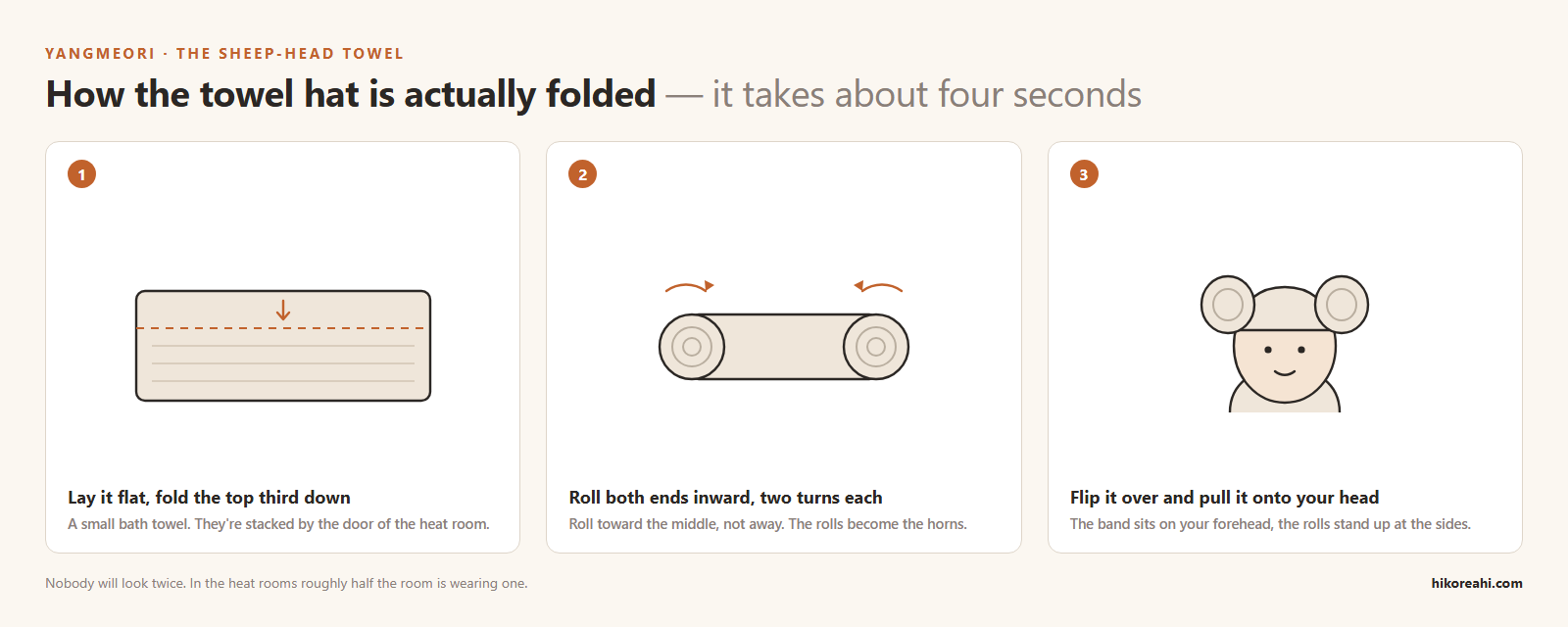
Four seconds, once you’ve done it once. Fold the top third down, roll both ends inward toward the middle, flip it over, pull it on. Nobody will find it funny that you’re wearing one. They’d find it mildly odd if you weren’t.
Step 7: The scrub is a separate transaction
Sesin — the full-body scrub — is not included in your entry, and it doesn’t happen upstairs. It happens back down on the bath floor, on a vinyl table, delivered by an attendant who has done this ten thousand times and has precisely no interest in your modesty.
How you book it depends on the house. Sometimes you tell the front desk on the way in. Sometimes there’s a numbered board on the bath floor and you take a ticket. Sometimes you catch the attendant’s eye and they nod at the table. It is almost never a real appointment, which means the answer to “when can I have one” is usually “wait over there.”
I’m not going to quote you a price, for the same reason as before — it’s set per venue and I can’t verify anyone’s. What is reliably true is the proportion: at most places the scrub costs more than getting in did, often a good deal more, so it roughly doubles what you thought the evening would run to. It’ll be listed on the same board as everything else.
Worth knowing separately: women’s rates are frequently set higher than men’s at the same place for the same service. That gap has been argued about in the Korean press for years and hasn’t really moved.
It does hurt a bit. Not injury-hurts, but the first few minutes are a genuine surprise and you come off the table pink. Worth doing once even if you decide never again.
Step 8: Your money stays in the locker
This is the part almost nothing written in English bothers to explain, and it’s the part that makes the whole place function.
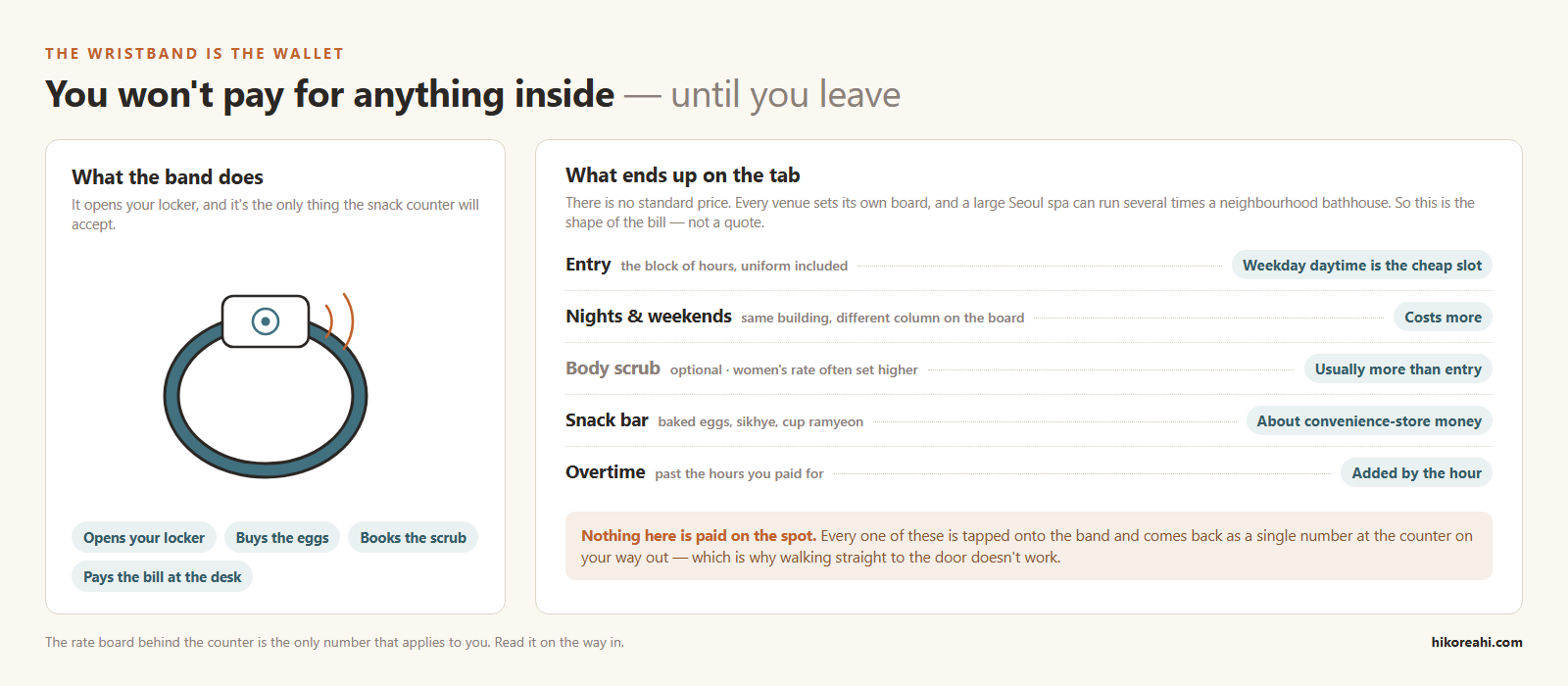
You don’t pay for things inside. Not the eggs, not the sikhye, not the cup ramyeon handed across the snack counter, not the extra hour you accidentally stayed. All of it gets charged against your wristband. You hold the band out, they scan it, you take your food and walk away — and it feels exactly like shoplifting until you get used to it.
Which means leave your wallet in the locker. Carrying cash around the common floor is pointless, and the uniform doesn’t have a pocket worth trusting anyway.
It also means the running total is invisible. If you’re the kind of person who likes knowing where the number is, keep a rough tally in your head, because two eggs, a sikhye, a ramyeon and an hour of overtime stack onto the entry fee faster than they feel like they should. Snack bar prices sit roughly where a convenience store’s do, give or take — nobody is gouging you. It’s just that there’s never a moment where you hand over money and reconsider. To see what the won figures on the counter board come to in whatever currency you actually think in, our Korean won converter runs at the live rate.
Step 9: And then you get stuck at the door
Here’s the failure mode, and it happens constantly.
You’ve had a good time, you’re dressed, you walk toward the exit — and there are no shoes, because the counter still has your shoe key, and they aren’t handing it back until the tab is closed.
The exit is the checkout. Go to the counter, give back the wristband, they pull up everything you charged all evening and read you one number. Card or cash. Then you get the shoe key, and then you get your shoes.
It’s a neat little loop once you see it — your shoes are the deposit that guarantees you can’t leave without paying. But if nobody has told you, you stand there confused while a staff member points at a screen you can’t read, and it’s an oddly deflating way to end a nice evening.
How long can you stay, and can you sleep there?
Entry usually buys a block of hours rather than a whole day. Twelve is a common figure, with anything past it added to the same tab by the hour. Plenty of places still run all night — fewer than there used to be, since a lot of 24-hour operations quietly stopped being 24 hours over the past few years. Read the sign at the counter instead of assuming.
The sleeping room is dark, silent, and full of strangers. Some have reclining chairs. More have a heated floor, a stack of thin mats, and hard block pillows you’ll hate for ten minutes and then stop noticing. Bigger places often have a separate women’s sleeping room, which is worth asking about at the desk rather than hunting for.
The etiquette is short enough to list. No talking. No phone screen — the light travels much further in a dark room than you think it does. Take one mat, not three. Someone will snore, spectacularly, and there is nothing to be done about that. And leave anything valuable in your locker, because the sleeping room isn’t watched by anyone.
Even on the higher overnight rate, it’s the cheapest legal place to sleep in most Korean cities — normally well under a hostel dorm bed, which is why you’ll always see a few people in there who are very obviously between trains. If you’re pricing a trip and want to know what swapping a couple of hostel nights for this does to the total, the Korea trip budget calculator does that arithmetic for you.
Small things that help
Bring nothing. Towels, uniform, usually soap — it’s all there. A hair tie if you have long hair, and that’s about the extent of it.
Contact lens wearers get a raw deal here: the hot rooms dry your eyes out fast, so glasses are the better call, except metal frames get genuinely hot in the hottest room and you’ll end up taking them off anyway. There’s no winning that one.
You don’t need much Korean. Pointing, nodding and holding up fingers gets you through the entire evening. If you’d rather have a couple of phrases ready for the counter, our survival Korean post covers the ones that actually come up.
One straight opinion, since I get asked. I don’t like the hottest room and I never have. The kiln everyone treats as the main event gives me a headache in about four minutes, and I’ve watched enough people stagger out of it clutching a towel to know I’m not the only one. Warm salt room, ice room, back and forth, with an egg somewhere in the middle — that’s the better evening. Nobody is grading you on which door you walk through.