Ring sizes are the one conversion where Korea is easier than everywhere else, and almost nobody tells you why. A Korean ring size is written as a number followed by the character 호 — 11호, 17호. That character is romanised ho and it simply means “number”, so an 11호 is read as “11 ho”. It and that number is not a code. It is the inside circumference of the ring in millimetres, minus forty-three. An 11호 ring measures 54 mm around the inside. A 17호 measures 60 mm.
Which means you can work out your own size with a strip of paper and a ruler, and be right to within one number. Use the tool if you already know your US or UK size; read on for the measuring method, because it is more reliable than any conversion.
What is my ring size in Korea?
Korea numbers rings from about 1호 to 30호 on a single scale that both men and women use. There is no separate men’s ladder. A 17호 is a 17호 whether it is a wedding band or a silver ring from a market stall, and the number climbs in steps of exactly one millimetre of inside circumference.
That one-millimetre step is the thing to hold on to, because it makes Korean sizing finer than the American system. One US size is about 2.5 mm of circumference, so a single US size covers roughly two and a half Korean numbers. Going up one 호 is a small adjustment. Going up one US size is not. If a ring has ever fitted you badly in the gap between a 6 and a 7, Korea has three sizes in there.
Korean shops will ask you directly: 몇 호세요? — “what number are you?” Answer with the number and nothing else. You will not be asked for a country.
Measure your finger and subtract 43
Cut a strip of paper about 5 mm wide, or use a length of string or dental floss. Wrap it around the base of the finger you intend to wear the ring on, snug but not tight — it should feel like the ring will feel, not like a tourniquet. Mark where the end overlaps, unwrap it, and measure the marked length in millimetres.
That number, minus 43, is your Korean ring size. Measure 54 mm and you are an 11호. Measure 60 mm and you are a 17호. Measure 51 mm and you are an 8호. There is no chart and no arithmetic beyond one subtraction, which is why this is the only sizing system on this site we would tell you to trust over our own tool.
Two cautions on the measuring. First, measure in the evening rather than first thing in the morning, and not straight after exercise or a hot shower — fingers swell by a surprising amount, and a ring sized in a Korean July can be uncomfortable in January. Second, check that the strip will actually pass over your knuckle. If your knuckle is noticeably wider than the base of the finger, measure both and pick something between the two, closer to the knuckle. A ring that spins on your finger is annoying; a ring that will not come off is a trip to a jeweller.
Or let the shop measure you
Every 금은방 (geum-eun-bang, a gold-and-silver shop) in Korea keeps one of these behind the counter: a hoop of metal test rings, one for each 호, strung together like a heavy keyring. In Korean it is a 링게이지 (ring-ge-i-ji) — the English words “ring gauge” written in Korean letters. You do not need to know your size in advance, speak Korean, or buy anything. Hold out your hand, and they will hand you the hoop. Work along it until one slides on with a little resistance and comes back off over the knuckle without a fight. The number stamped on that ring is your 호. The phrase, if you want it, is 반지 호수 좀 재주세요 — “could you measure my ring size?”
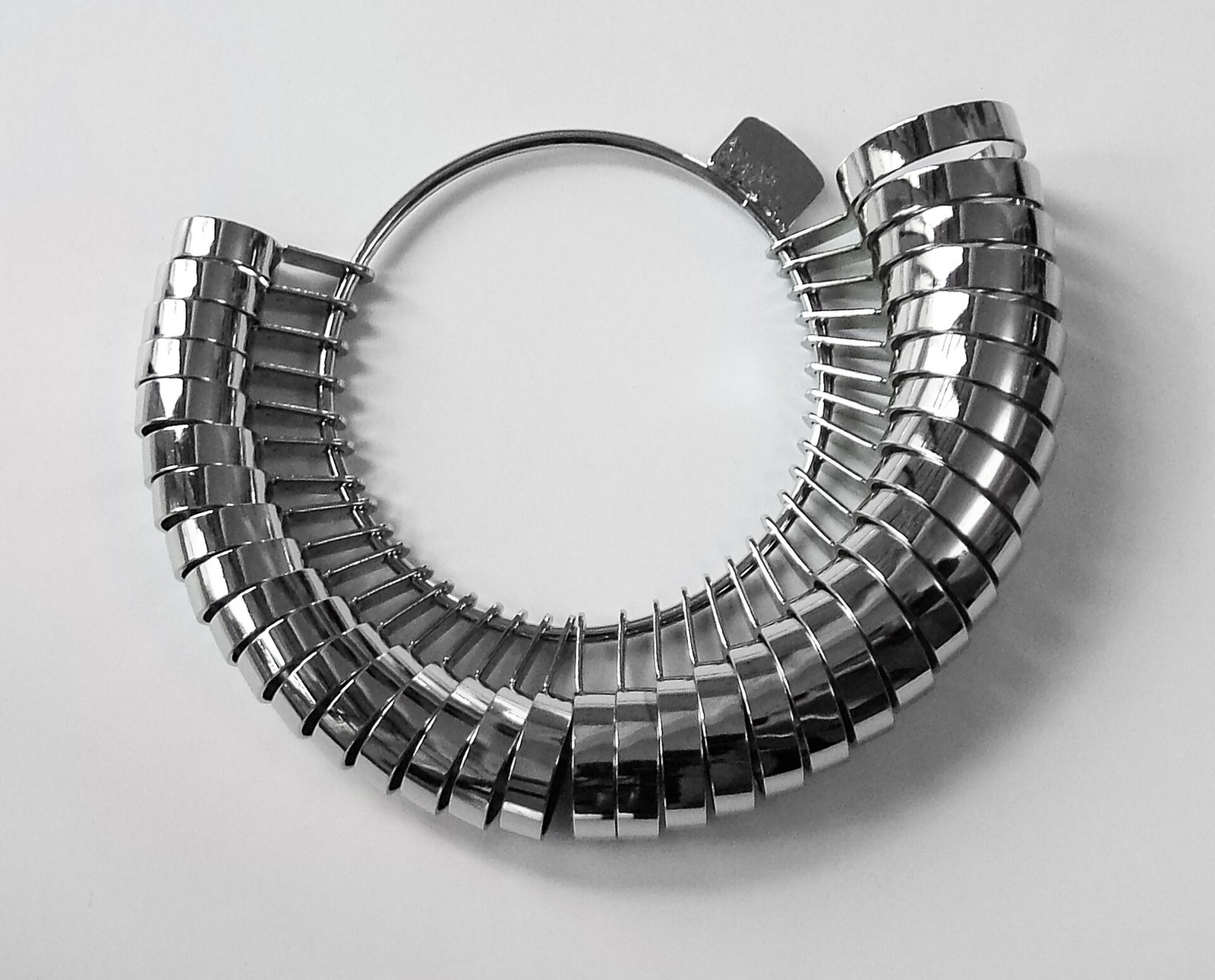
This beats measuring at home, and it takes about thirty seconds, because it tests the two things a paper strip cannot: whether a ring will actually clear your knuckle, and how a rigid band feels at the base of your finger rather than how a flat strip of paper feels. Use the hand you will actually wear the ring on — for most people the dominant hand is half a 호 to a full 호 larger — and try the two numbers either side of the one that seems right rather than stopping at the first that fits.
The paper strip is the method for everyone else: buying online, not in Korea yet, or shopping for someone who is not standing next to you. It will get you within one number, which is close enough for a plain band and not quite close enough for something you cannot resize. The cheap plastic sizers sold online are the same idea as the shop’s metal hoop, but they are marked in US or EU sizes rather than 호 — read the number off one and put it into the tool above.
Korean ring size to US and UK
Because the two systems have different step sizes, the conversion is never quite exact, and any chart that gives you a clean one-to-one mapping is rounding without telling you. A US 7 lands almost exactly on 11호. A US 6 lands on 9호. A US 9 is a 17호. Between those, some US sizes fall neatly onto a Korean number and some sit between two, and our table rounds to whichever Korean number is closer.
The UK scale uses letters and steps in units of its own, so it drifts against both. A UK N½ is an 11호, a UK R½ is a 16호. Past 27호 the UK alphabet has run out, which is why those rows are blank.
EU and ISO sizing is the simplest relationship of all: an EU ring size is the inside circumference in millimetres. So an EU 54 is a Korean 11호, and the conversion is the same subtraction you did with the paper strip. If a listing gives you a number in the fifties or sixties with no letters attached, that is almost certainly what you are looking at.
What the common numbers are
Korean jewellers generally treat 12호 as the average women’s size and 17호 as the average men’s size, and stock accordingly. In US terms that is about a 7 and a 9 — not far from the averages quoted in Western shops, which is worth knowing if you were expecting Korean sizes to run small the way clothing does. Fingers are fingers.
In practice, women’s rings are most commonly stocked from about 8호 to 14호 and men’s from about 15호 to 22호. Outside that range you are usually ordering rather than buying off a tray, though the made-to-order culture in Korea is strong enough that this is a mild inconvenience rather than a problem.
Couple rings — 커플링 — are a whole category here in a way they are not in most countries, sold as a pair in two different 호 numbers, and any shop that sells them will size both of you on the spot with a set of steel gauge rings. If you are buying a pair, that is a better use of ten minutes than measuring at home.
What changes the size you need
Band width is the big one, and it is the mistake most people make. A narrow band sits in the groove at the base of your finger; a wide band has to clear more of it, so it feels tighter at the same measurement. For a band over about 5 mm, go up one or two 호. Korean shop staff will usually raise this before you do, but online you are on your own.
Fit style matters too. A comfort-fit band, domed on the inside, slides on more easily than a flat one, so you can sometimes stay at your measured size or even drop one number. Season matters: hands are measurably larger in humid Korean summers than in the dry cold of a Seoul winter, and a ring bought in August at exactly your size may spin in February.
Finally, resizing. Plain metal bands can usually be resized a couple of numbers in either direction, and jewellery districts in Seoul will do it quickly and cheaply. Rings with stones set all the way around, or made of tungsten or titanium, generally cannot be resized at all. If you are buying one of those, it is worth being measured properly rather than trusting a paper strip — including this page’s paper strip.
Buying a ring in Korea
Most ring buying in Korea happens in a 금은방, and these cluster rather than spread out. Jongno 3-ga in Seoul is the dense version — several streets of nothing but jewellery, wholesale and retail side by side — and most neighbourhoods have a handful of their own near the market. Walking into one is not the intimidating experience the window displays suggest; sizing you with a set of gauge rings is a thirty-second courtesy and nobody expects you to buy afterwards.
Gold is where the pricing works differently from what you may be used to. It is sold by weight in 돈 (don), a traditional unit equal to 3.75 grams, and the shop quotes the metal at that day’s rate plus a separate charge for the workmanship, called 공임 (gong-im). The metal price is not really negotiable because it moves with the market; the 공임 sometimes is. Purity is usually marked in K rather than in parts per thousand, and 14K and 18K are far more common in everyday Korean jewellery than the 9K you see in Britain.
One thing worth knowing if you are buying a gift: the 돌반지 (dol-banji), a small gold ring given to a baby on their first birthday, is a fixture of Korean life and traditionally weighed one 돈. Gold prices have pushed a lot of families down to a half or a third of that, and shops now stock the smaller weights as standard. If someone asks you what a 돌반지 is, that is the answer, and it explains why every jewellery shop in the country keeps a tray of rings far too small for any adult finger.
If you are shopping for clothing or shoes as well, the same logic applies but the numbers are unrelated: our Korean size converter covers tops, bottoms, bras and underwear, and the Korean shoe size converter handles footwear, where the number is your foot length in millimetres. Prices are quoted in won with no tax added at the till, which our Korean won converter will turn into something you can judge at a glance.
Renting rather than shopping? Korean listings measure floor space in pyeong, and the number on the listing is not the number on the contract. Our pyeong to square metres converter does both, and explains the gap.