Jagalchi Market is the kind of place people photograph a lot and actually eat at surprisingly little. I get it — the fish tanks, the ajummas shouting prices, the smell that hits you two blocks before you arrive. It’s a lot. But if you only wander through gawking and never sit down at one of the stalls, you’re missing the better half of the experience.
I’m not really a tourist-spot person as a rule, but Jagalchi is one of the few touristy places I keep going back to anyway. Not for the souvenir photos. For the food.
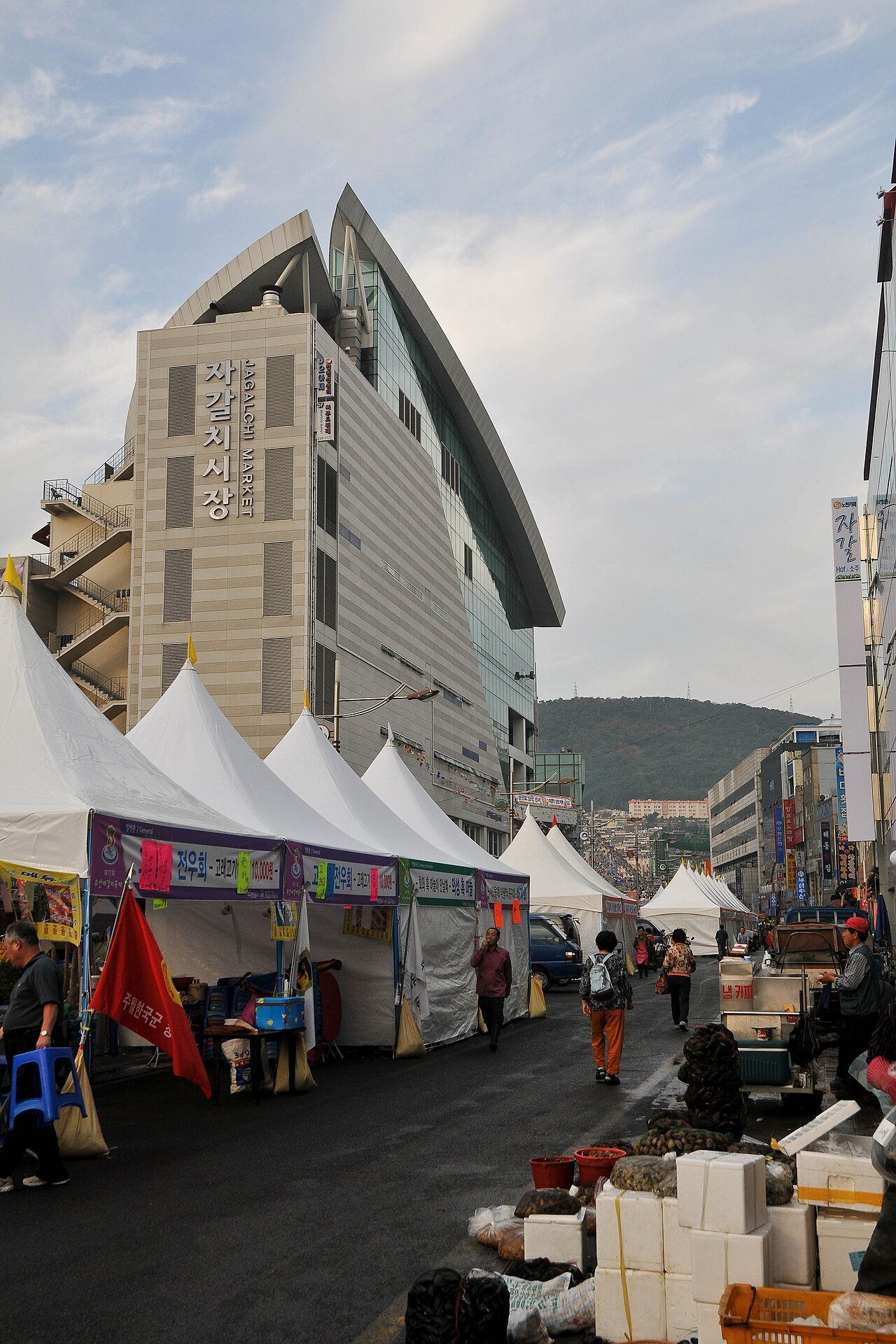
Getting There Without Wasting Half a Day
Take Busan Metro Line 1 to Jagalchi Station, Exit 10, and walk straight for about five minutes. You’ll smell it before you see the building. If you’re coming from Nampo-dong or Gukje Market, it’s an easy ten-minute walk along the water — worth doing once just to watch the boats unload in the morning.
Go before 10am if you want to catch the market in full swing — boxes of live octopus, mackerel still twitching, ajummas restocking ice. By early afternoon a lot of that wholesale energy dies down and it starts feeling more like a tourist stop. Winter, roughly November through February, is when the crab and oyster stalls really come alive, and honestly the smell is a lot less brutal in the cold than on a humid August afternoon downtown.
Check the day before you go, because this catches people out: Busan’s official tourism listing gives the market’s hours as 05:00 to 22:00 and its closing days as the first, third and fifth Tuesday of each month. I checked that on 11 September 2026. It’s the fifth-Tuesday part that surprises everyone, since some months have one and some don’t — on a closing day the main building is shut and the street around it is a fraction of itself. Individual outdoor stalls keep their own hours regardless, so you’ll still find something, just not the market you came for.
A word on the dawn visit, since people ask about watching an auction. The market opens at five, and the early hours are unloading, sorting and wholesale trading rather than a public auction with a viewing gallery. Busan’s actual fish auctions happen at separate wholesale markets elsewhere in the city, and they’re workplaces rather than attractions — times aren’t posted for visitors, so if that’s what you want, ask locally rather than turning up at 3am on the strength of a blog post. What you get at Jagalchi at six in the morning is better anyway: the place working at full speed with almost no tourists in it.
Build it into a half day rather than a special trip. Jagalchi, Gukje Market, BIFF Square and Nampo-dong are all within about ten minutes’ walk of each other, and they chain together naturally: market in the morning, the alleys of Gukje for whatever you’re not going to buy, the food stalls at BIFF Square when you’re hungry again, then Nampo-dong for coffee and the cinema crowds. That’s an afternoon without ever needing transport.
Skip the Upstairs Restaurants (Mostly)
Here’s the thing nobody tells you: the sit-down seafood restaurants on the second floor of the main Jagalchi building are priced for tourists, and the menus rarely show real numbers until you ask. I’ve paid almost 80,000 won for a plate of raw fish that would’ve cost half that two blocks inland. It’s not exactly a scam — it’s prime real estate with a harbor view — but know what you’re paying for.
The better food, honestly, is on the ground floor and out on the street stalls.
But the part that confuses foreigners most isn’t the price, it’s the system, because Jagalchi doesn’t work like a restaurant at all. The way it actually runs: you buy the fish downstairs from a stall, alive out of a tank or fresh off the ice. The vendor kills and cleans it for you. You then carry it upstairs — or to a small place at the back of the ground floor — where a kitchen takes your fish, slices it, and serves it to you at a table. You’re paying two separate people for two separate things, and nobody explains this to you at any point.
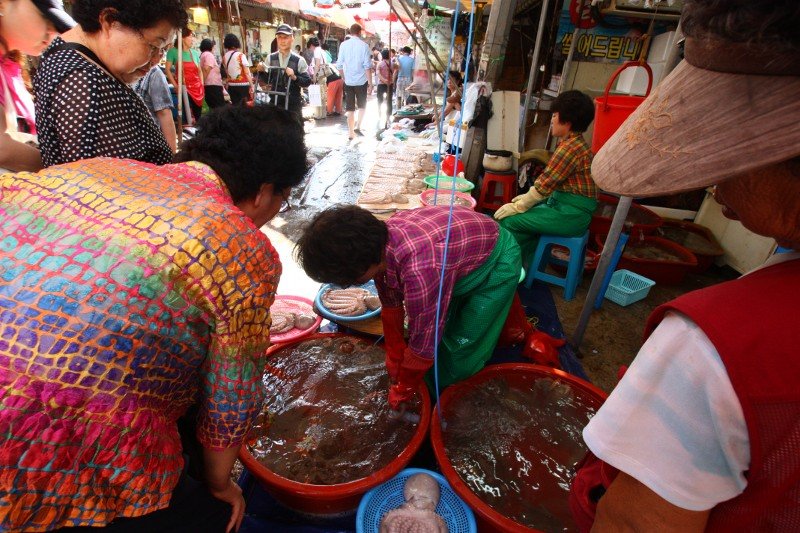
The second payment is the sangcharim, a per-person table charge. What it buys is everything that isn’t the fish: the banchan, the lettuce and perilla leaves, the garlic and chilli and sauces, the plates and the seats, and — the part people don’t expect — a pot of maeuntang at the end, the spicy stew they make from the head and frame of the fish you just ate. That stew arriving is the signal the meal is over, and for a lot of Koreans it’s the best part of the whole thing.
I’m not going to quote you a figure for the table charge, because nobody publishes one — it’s set per restaurant, it moves with the season and the floor, and the honest instruction is to ask before you hand over the fish rather than after. Say sangcharim eolmayeyo? and you’ll get a straight number.
Which brings me to the rule that matters more than any other at this market: agree the total price before anything gets cut. Seafood here is quoted by the kilo, and a fish that looks modest in a tank can come in well over a kilo, so a per-kilo number you nodded along to turns into a bill two or three times what you had in your head. Once it’s been killed and sliced, the negotiation is over. Point at the fish, ask ige da hamyeon eolmayeyo — how much for all of this — and wait for a single total in won, not a rate. Vendors deal with this question constantly and won’t be offended by it.
And the “mostly” in the heading is doing real work, because upstairs is sometimes exactly right. If it’s raining, if you’re a group of four or more, if you want to sit at a table with the harbour in the window rather than on a plastic stool, or if you simply don’t want to negotiate in a language you don’t speak, then take the easy option and accept the markup as the price of a chair. What you shouldn’t do is end up there by accident, which is what happens to most first-timers.
What’s Actually Worth Eating
Sannakji (live octopus). If you’re brave enough, buy it fresh from one of the ground-floor vendors — they’ll cut it up right there in front of you. It’s still moving on the plate. Dip it in the spicy gochujang-vinegar sauce, chew properly (seriously, chew), and don’t overthink it. Expect around 15,000–20,000 won for a small portion.
Grilled mackerel and saury. The stalls along the outer edge grill whole fish over charcoal and sell it by the piece, usually 5,000–8,000 won depending on size. Eat it with your hands, bones and all if you’re not fussy, standing at one of the plastic tables.
Odeng (fish cake skewers). Cheap, hot, and the broth alone is worth the 1,000 won. Good for something warm while you walk — Busan winters by the water are no joke.
Ssiat hotteok. Not technically from Jagalchi itself, but the stalls near the Gukje Market entrance sell the seed-filled version, which is better than the plain cinnamon kind you get up in Seoul. Go on a weekday if you don’t want to queue twenty minutes for a 2,000 won pancake.
Kkomjangeo (grilled hagfish). This is Busan’s dish more than anywhere else’s, and it’s the one I’d push a curious eater toward. Cut into short lengths and grilled at the table, either salted or in a red pepper sauce that gets progressively more aggressive, with a texture somewhere between squid and pork belly. Chewy, smoky, made for sharing over drinks. If you like Korean barbecue and aren’t squeamish about the name, you’ll be fine.
Hoe (raw fish). Worth understanding rather than assuming, because it isn’t sashimi. Korean hoe is usually cut from a fish that was alive minutes ago rather than aged, and the prized quality is firmness — a springy, almost crunchy bite rather than the soft melt a Japanese restaurant is aiming for. It’s not usually eaten alone with soy and wasabi either. You take a slice, put it on a lettuce or perilla leaf, add a smear of chojang (sweet-sour red pepper paste) or ssamjang, maybe a sliver of raw garlic or green chilli, sometimes a strip of sour aged kimchi, and eat the whole parcel in one go. Flounder and sea bream are the safe starting points. This is the dish that the whole downstairs-upstairs system exists for.
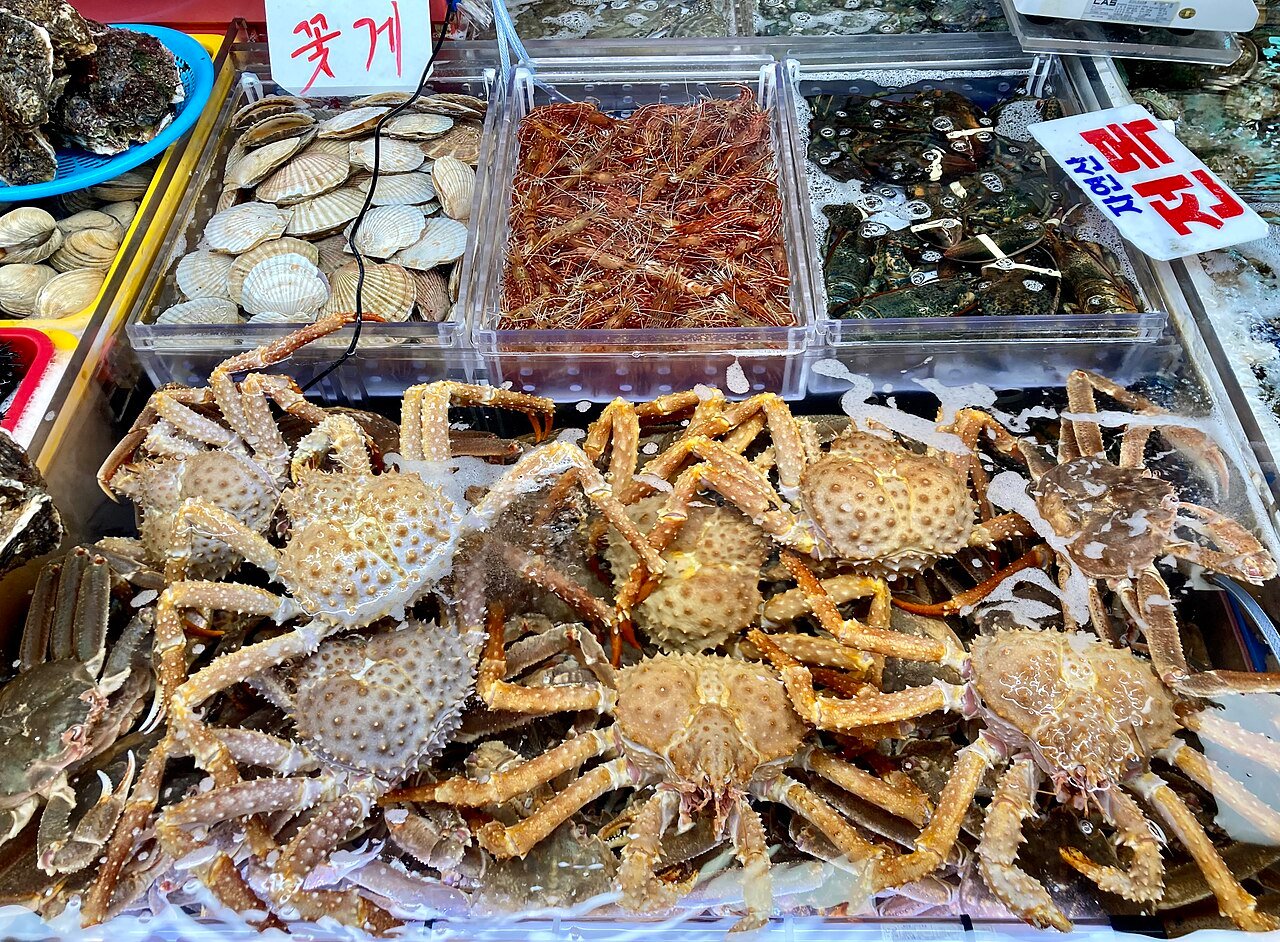
Winter: snow crab and abalone. From roughly November into early spring the crab tanks are the centre of attention, sold by weight and steamed while you wait; the leg meat is sweeter and cleaner than anything you’ll get from a crab that’s travelled. Abalone is the other cold-weather order — grilled, or raw in thin slices, or in porridge if you want something gentle. Both are genuinely expensive, so the price-before-cutting rule applies twice over.
Season matters more here than at a normal restaurant, because this is a market and the market only has what came in. Winter is crab, oyster and abalone. Autumn, gizzard shad (jeoneo) turns up everywhere and locals get unreasonably excited about it. Summer leans toward grilled eel and shellfish, and it’s the weakest season for raw fish. If you don’t know what’s good on the day, ask a vendor what’s best right now rather than what they recommend — the first question gets you the honest answer.
A Few Honest Warnings
Cash still works better than cards at most of the outdoor stalls, even though card machines have gotten more common the last couple of years. There’s an ATM inside the main building if you get caught out.
English menus are rare outside the main tourist restaurants. Pointing works fine. So does a translation app, though half the vendors will just laugh and hand you what they think you want anyway — which, honestly, has never once been a bad choice for me.
Be more careful with raw seafood in summer than you would be in winter, and notice that Koreans are. From roughly June to September the water is warm, the news runs its annual food-safety warnings, and a lot of locals quietly switch from raw to cooked for a few months — grilled fish, steamed shellfish, stew. Raw oysters in particular are a winter food here, not a summer one; you’ll see them everywhere in January and almost nowhere in August, and that’s not a supply problem. Nobody will stop you ordering hoe in August, and plenty of people do, but if your stomach is at all cautious, follow what the locals around you are eating.
On the sannakji: chew it properly and don’t swallow pieces whole. The suckers still grip on the way down, and the reason that warning exists is that people have genuinely got into trouble not following it.
And don’t go in expecting it to be quiet or polished. It’s a working market. Slippery floors, crowded aisles, the occasional bucket of water sloshed near your shoes. That’s the whole point, really — it hasn’t been tidied up for visitors, and I’d rather it stayed that way.
My Honest Take
If you’re only in Busan for a day or two, Jagalchi is worth an hour of your time even if seafood isn’t your thing — the street food outside the main building alone is reason enough to detour. Just eat outside, bring cash, and don’t let the upstairs menu prices talk you into paying for something you never meant to order.
Read next
- Gwangjang Market: What to Actually Eat at Seoul’s Oldest Food Market — The Seoul equivalent, and a very different market.
- Haeundae, Gwangalli or Marine City: Which Busan Beach, and When — All three of Busan’s coastal names, and which one to see when.
- Survival Korean: What to Say at Restaurants, Shops, Cafes, and in a Taxi — The handful of phrases that make ordering here easier.