The first time I ordered mayak gimbap here, the ajumma had it wrapped and in my hand before I’d finished saying the word “one.” No menu, no hesitation, just a practiced motion she’s probably done ten thousand times. That’s Gwangjang Market in a sentence — fast, loud, and completely sure of itself.
It’s been running since 1905, which makes it one of the oldest markets in the country, but it doesn’t feel like a museum piece. It feels like lunch rush, permanently.
Finding the Food Alley
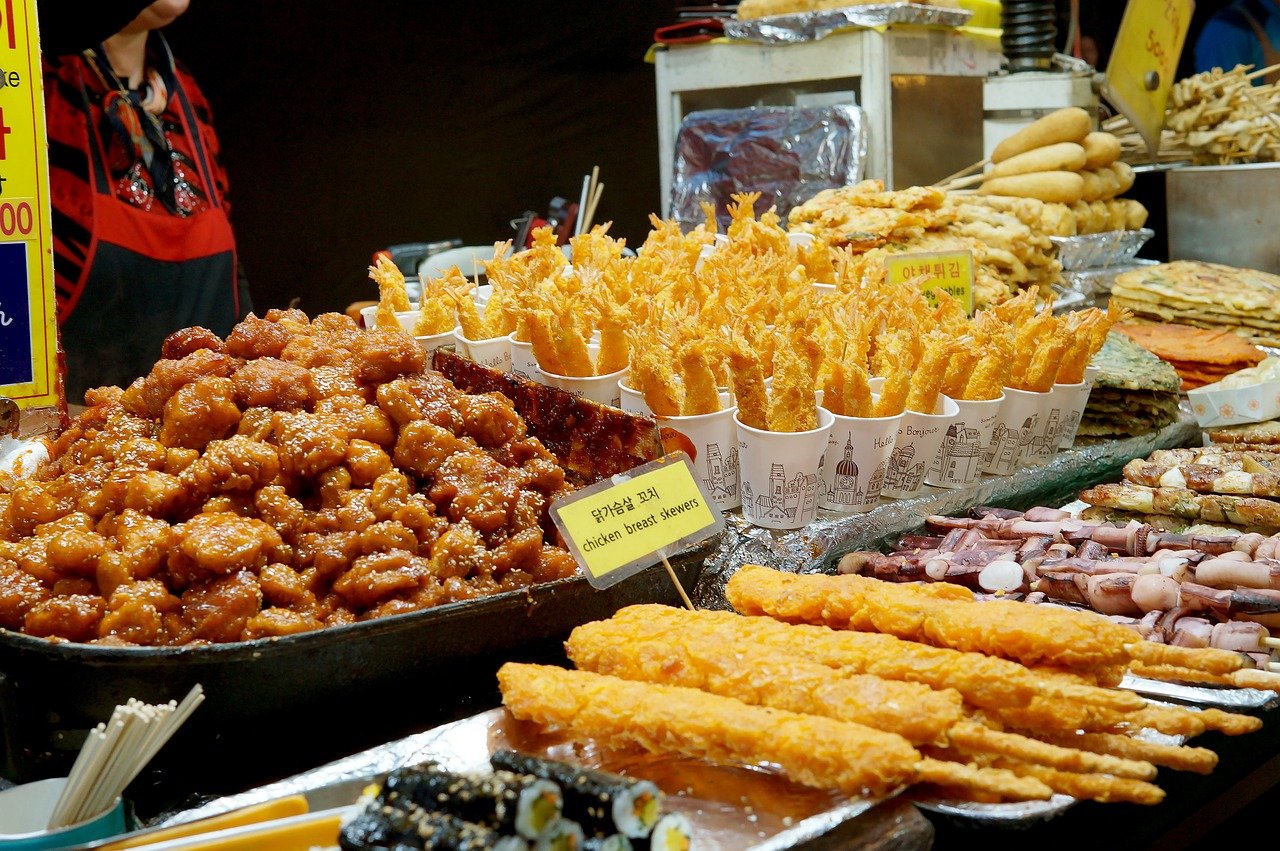
Take Line 1 to Jongno 5(g)a Station, Exit 8, and you’re basically dropped at the market’s edge. The clothing and fabric section sprawls out on one side — this used to be Korea’s biggest textile market, and some of that trade is still very much alive — but you want the covered food alley, tucked toward the center. This is the part most people actually mean when they talk about Gwangjang Market street food. Ask anyone for “meokja golmok” (먹자골목) if you get turned around; it works better than any map app I’ve tried there.
Late morning through early afternoon is the sweet spot. Go past 7pm and half the stools are already packed with office workers three drinks into their soju, which is its own kind of fun but a different experience than a quiet lunch.
Exit 8 is the easiest approach but it isn’t the only one. Euljiro 4-ga (Lines 2 and 5) leaves you a short walk from the market’s western end, and if you’re coming from Dongdaemun you can simply walk west along the main road for about ten minutes. The market has entrances on all four sides and they aren’t signposted as one building, which is why people circle it — if you find yourself among bolts of fabric or racks of secondhand coats, you’re in the market, just not the part you wanted. Head inward and toward the noise.
Hours are worth checking because the two halves of the market keep different ones. The market’s own site gives the general trading hours as 09:00 to 18:00 with Sundays closed, the secondhand clothing arcade as 10:00 to 19:00, also closed Sundays — and the food alley open until 11pm with no regular closing day. That last line is the one that matters: come on a Sunday and the fabric traders are shut while the food alley is running. Individual stalls set their own hours within that, so a specific place you read about may be dark on the day you turn up.
Evening is a genuinely different market from lunchtime. During the day it’s shoppers, older regulars and tourists eating standing up; after about seven the tables fill with people drinking, the pancake griddles run non-stop, and the volume goes up several notches. Neither is better. Lunch is for seeing what you’re eating, evening is for staying two hours longer than you planned.
One more thing about the location that nobody mentions: Cheonggyecheon runs right past the market’s south side. If you’ve overeaten, the stream is thirty seconds away and walking it back toward the city centre is the easiest possible digestion plan — I wrote about that walk in the outdoors in Seoul post.
Mayak Gimbap: Small, Cheap, and Actually Addictive
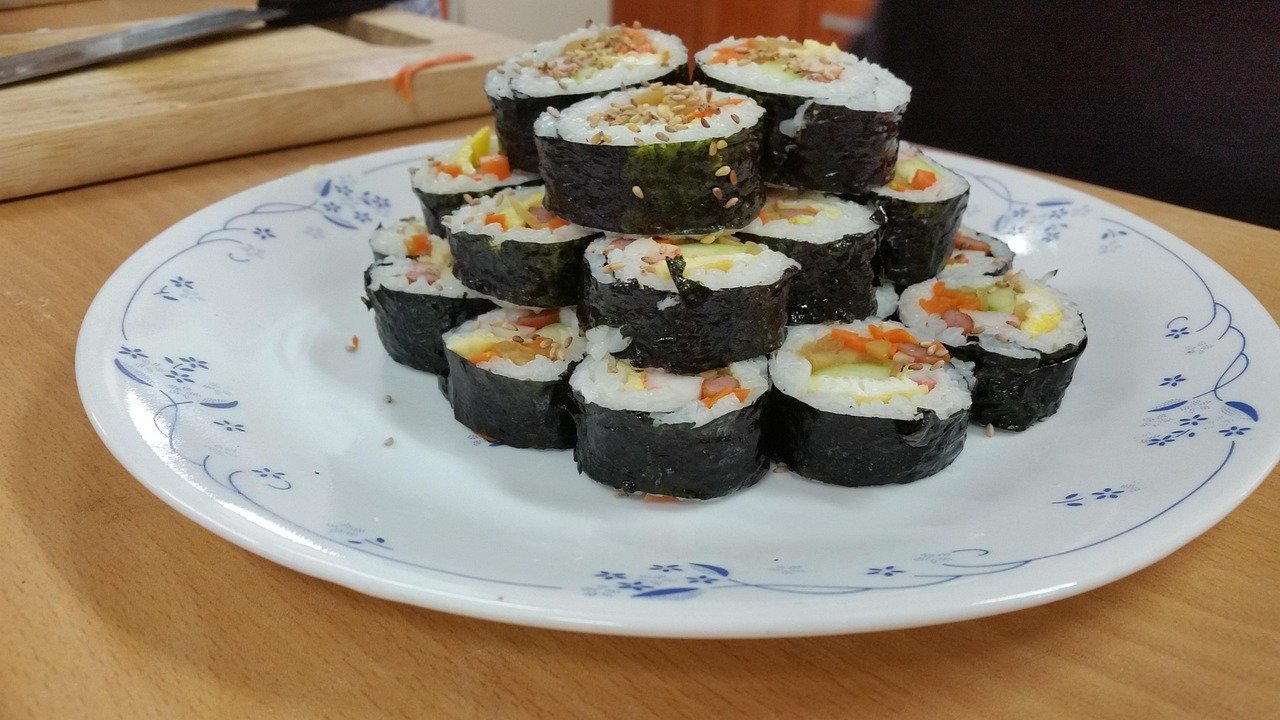
The name translates to something like “drug gimbap,” which sounds alarming until you realize it’s just marketing — nobody’s put anything in it, it’s just genuinely hard to stop eating. Bite-sized rolls, no vegetables to speak of beyond pickled radish and carrot, dunked in a mustard-soy sauce that’s sharper than you’d expect. A plate runs about 4,000 to 5,000 won and disappears in under two minutes if you’re not careful.
There are three or four stalls all claiming to be the “original,” lined up almost shoulder to shoulder. Honestly, I can’t tell much difference between them, and I’ve tried. Pick whichever line looks shortest and you’ll be fine.
Eat it the way the stall intends: pick up a roll with your fingers or chopsticks, drag it through the yellow mustard-soy sauce in the little dish, and don’t skip that step — the rolls are deliberately plain and the sauce is the whole flavour. The shredded seaweed and sesame on top go with it rather than being decoration. And calibrate your expectations: a plate is a snack, not lunch. It’s meant to be the thing you eat while deciding what else to order, or the thing you add to a plate of pancakes. People who make it their whole meal leave hungry and slightly confused about the fuss.
Bindaetteok, Yukhoe, and the Stuff Worth the Detour
Bindaetteok — the mung bean pancake — is the other reason people make the trip. Thick, greasy in the good way, fried on massive flat griddles you can watch from three feet away. Get it fresh off the pan, not one that’s been sitting under a heat lamp; ask the vendor to make a new one if the pile looks tired, they don’t mind.
If you’re comfortable with raw beef, the yukhoe stalls near the center of the alley are worth a stop. Thinly sliced, seasoned with sesame oil and a raw egg yolk on top, served with julienned Korean pear. It’s not cheap by market standards — expect somewhere around 15,000 to 20,000 won for a plate that’s actually enough for two — but it’s a completely different texture from anything else in the alley, and I’d rather spend the money here than at one of the sit-down places nearby.
Worth knowing that the raw beef isn’t scattered through the food alley — there’s a lane of it, the yukhoe golmok, where the stalls sit side by side and the queues are their own thing. If the words “raw beef” are where you stop, here’s what it’s actually like: cold, silky rather than chewy, more sweet than meaty because of the pear and the sesame oil, and not remotely bloody in the way people brace for. You break the egg yolk into it and mix, and it becomes glossy and rich. The gentler entry point is yukhoe bibimbap — the same beef over rice with vegetables and gochujang, mixed until everything is coated, which spreads the rawness across a whole bowl and is the version I’d put in front of a hesitant friend. Same stalls, smaller leap.
And if you’re ordering bindaetteok, order makgeolli with it. That’s not a suggestion, it’s the pairing the dish exists inside — unfiltered rice wine, cloudy, faintly sweet and sour, served cold in a kettle with shallow bowls, and it cuts the oil of the pancake in a way beer doesn’t. A kettle is meant for sharing; pour for the person next to you rather than yourself if you’re with someone, which is the one drinking custom worth copying here. Soju is on every table too, but with a mung bean pancake, makgeolli is the answer.
Sundae (Korean blood sausage) and a bowl of kalguksu are the quieter options if the crowd’s getting to you. Neither will blow your mind, but both are solid, warm, and under 8,000 won. Janchi guksu — thin wheat noodles in a clear anchovy broth — belongs in the same category: about as plain as Korean food gets, cheap, and exactly right when you’ve eaten three fried things and need something that isn’t.
A Few Things Worth Knowing
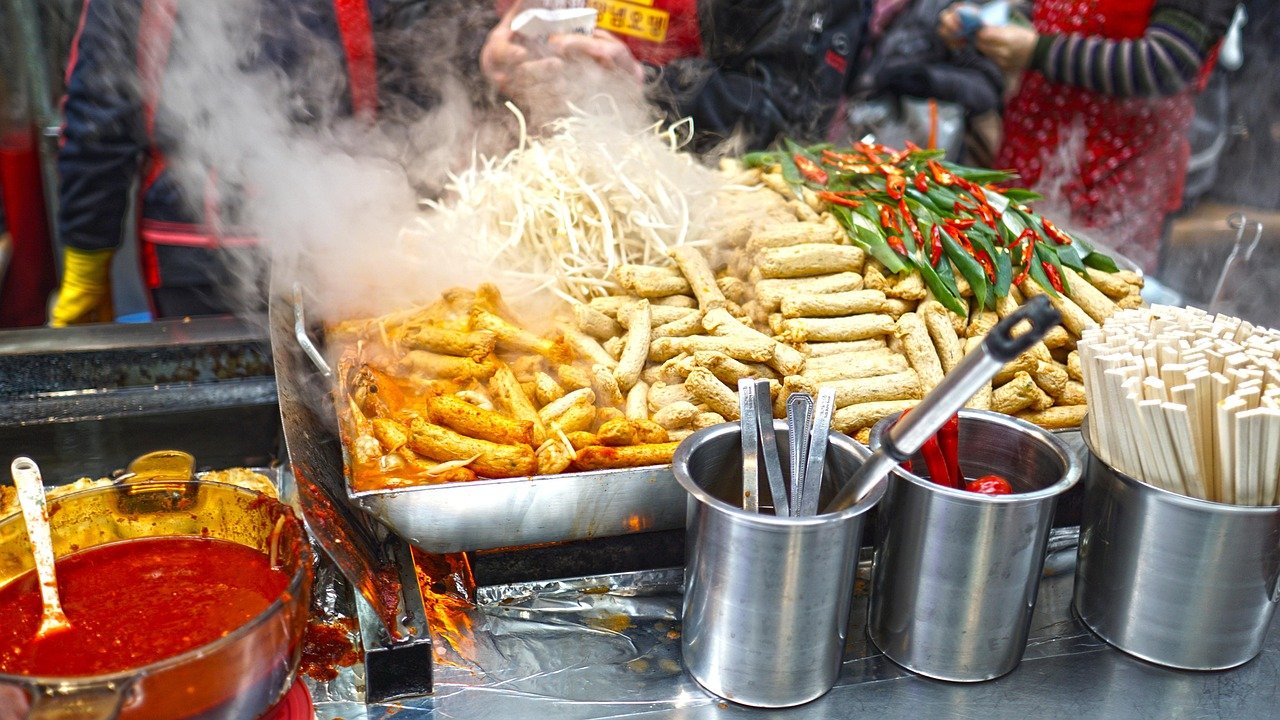
One thing worth saying plainly: Gwangjang runs more expensive than most traditional markets in Seoul. Namdaemun or Tongin Market will get you a similar spread of food for noticeably less. Some of that’s just fame — every food show and guidebook has filmed here at this point, so the stalls know exactly what they’re worth. Prices are usually posted right there on little signs, so you’re rarely guessing, but don’t walk in expecting bargain-market prices just because the stools are plastic and the floor’s a bit sticky.
And I should be straight with you about the other thing, because Korean media has covered it every year since 2023 and a foreign visitor is more likely to run into it than I am. Gwangjang has a documented overcharging problem. It started with a video in November 2023 — a ₩15,000 mixed pancake plate that arrived with about ten small pieces on it, and pressure to order more — and it kept going: a ₩6,000 sundae that became ₩10,000 once offal was added without being mentioned, dumplings quietly swapped for a cheaper filling at double the price, a stall in late 2025 selling an ₩8,000 sundae for ₩10,000, and in spring 2026 a case of foreign customers being charged ₩2,000 for water. A separate 2026 story about a restaurant reusing ice pulled from a bin ended in a ₩1.5 million fine rather than a suspension, which is roughly when locals stopped defending the place online.
The part that usually gets left out of the outrage cycle is that the market has not ignored it. The merchant association suspended the 2023 pancake stall for ten days and the 2025 sundae stall for another ten, and gave the water stall three days. Seoul city, Jongno-gu and the merchants introduced a set of measures: quantity labelling — the portion size printed next to the price on the menu board — food models placed at stalls so you can see what a serving looks like, a joint committee that has to agree price rises rather than leaving them to individual shops, and mystery shoppers who can report stalls for suspension. The association runs seller training twice a month and fair-price campaigns weekly. Jongno-gu has gone further with a street-stall real-name system, one stall per person with stricter price display, fully enforced from June 2026, under which a permit can be pulled after repeated violations.
It has also turned into open conflict between the traders themselves: in November 2025 the shopfront merchants’ association announced it was preparing a ₩300 million damages claim against the street-stall association, on the grounds that the overcharging stories were destroying trade for everyone. That’s not the sound of an industry in denial. It’s the sound of a market that knows exactly what the problem is costing it.
So, practically, how not to get caught. Check two things before you order, not one: the price and the portion — the quantity should be on the board now, and if it isn’t, ask irom myeot geu-yeyo or just point and ask how much comes. Don’t open with the big mixed platter, which is where nearly every complaint has come from; order a single plate of one thing, see the size, then add. Ask whether water is charged if a bottle appears. And if something arrives that doesn’t match what you agreed, say so at the stall right then, calmly — that’s the moment it gets fixed, and the association’s whole enforcement system runs on complaints that were actually made. Most stalls here are completely straight and have been for decades. The ones that aren’t are a small, well-documented group, and they count on you not saying anything.
Cash still moves faster here than cards, even though most stalls technically take them now. Small bills especially — nobody wants to break a 50,000 won note for a 4,000 won plate of gimbap, and you’ll get a look for trying.
Seating is shared plastic stools at communal tables, and you will end up elbow to elbow with strangers. That’s normal, not rude. Nobody’s going to talk to you, and you’re not expected to talk to them either.
The alley gets genuinely hot and a little sticky in summer, with all those griddles running at once in a covered space. Go earlier in the day if the heat’s an issue, or just accept you’re going to be a bit sweaty for the pancakes. Worth it either way.
My Honest Take
Gwangjang isn’t polished and it’s not trying to be. Half the appeal is that it hasn’t been redone for Instagram the way some other markets have. Go hungry, bring cash, and don’t overthink the menu — point at whatever smells best and you’ll probably end up glad you did.
Read next
- Jagalchi Market Street Food: What to Actually Eat in Busan — Busan’s version, older and fishier.
- Korean Convenience Store Food: What to Actually Buy (Price List Included) — When the market is shut.
- Korean BBQ Etiquette: What Actually Matters at the Table (and What Doesn’t) — Sitting down for the real meal.