A friend of mine came over from Chicago last spring and spent the better part of an hour in a shop in Hongdae before walking out with one t-shirt and a slightly insulted look on her face. She wears a US 8 at home. The biggest thing on the rack was labelled 66, and it did not fit.
This happens to almost everyone who visits, and it stings more than it should, because clothing sizes feel personal in a way that shoe sizes never do. So before anything else, the important part: it is not you. Korean clothes are cut smaller, the labels use a system nobody explains, and a good half of the racks in this country only ever stock one size to begin with. Here is what is actually going on, and what to do about it.
The numbers are the easy part
Most people arrive worried about the numbers. A women’s tag says 55 or 66 or 88, a men’s tag says 100 or 105, and shoes are labelled 250 or 270, which looks like nothing you have ever seen on a shoe.
Honestly, that part takes about fifteen seconds to learn. Women’s numbers are an old code that does not measure anything, men’s numbers are your chest in centimetres, and shoe numbers are the actual length of your foot in millimetres. I keep the whole conversion on one page, so if all you need is the chart, go and grab your number from the Korean size converter and come back.
The numbers are not what ruins people’s afternoons. These next four things are.
“Free size” is the real problem
Walk into a small shop in Hongdae, Ewha, or the wholesale floors at Dongdaemun and look for a size tag. Often there is not one. The rack says 프리사이즈, pronounced peu-ri sa-i-jeu, which is Konglish for free size, or sometimes 원사이즈, one size. It means the shop bought that piece in a single cut and that cut is roughly a Korean 55 to 66.
In US terms that is somewhere around a 4 to an 8, depending on how forgiving the shape is. If you are bigger than that, there is no larger one in the back. There is no larger one anywhere. This is the single biggest reason visitors leave Korean shopping streets empty-handed, and nobody warns them, because to a Korean shopper it is simply how small shops work.
The practical version: independent boutiques, street stalls, and most Instagram-style shops are free size. If you need an actual range of sizes, you want the places listed further down.
The same size really is cut smaller, and always in the same places
Say you do find a proper size run and you take your usual size into the fitting room. It still will not fit right, and it will fail in predictable spots.
Shoulders go first. Korean women’s tops are cut narrow across the shoulder and tight through the upper arm, so a shirt that closes fine at the chest will pull the moment you reach forward. Trousers fail at the seat and thigh, and the inseam is cut for a shorter leg, which is a nice surprise if you are 160cm and a bad one if you are 180cm. Men’s shirts are usually fine in the chest and short in the sleeve.
The fix is boring and it works: go up one size, sometimes two in anything fitted. The one exception is shoulders. If a top fits everywhere and only pulls across the shoulders, that is the cut rather than the size, and the next size up often will not fix it. Put it back.
Where the bigger sizes actually live
They exist. They are just not on the streets where tourists shop.
Department stores. Lotte, Shinsegae, and Hyundai carry real size runs, and the staff are used to pulling things from stock. This is the reliable option if you have one afternoon and no patience.
International chains. Uniqlo, Zara, H&M, Muji, Nike, Adidas. They use their own global sizing here, so the XL is the XL you already know, and it is on the floor rather than hidden online. If you are shopping with limited time and you already know your size in one of these brands, this is the shortcut.
Online. Musinsa is the big one, 29CM if you want the pricier end. Both let you filter by size, which the physical shops do not. The Korean search term worth knowing is 빅사이즈, big-sa-i-jeu, literally big size. Typing that into a Korean shopping site turns up an entire category that does not exist on any high street.
For men specifically. Department stores stock 105 and 110 without much trouble. Korean streetwear brands very often stop at 100, which is a US large, so if you wear an XL or above, skip the trendy Seongsu-dong labels and go to the department store floors or the international chains.
Shoes hit a wall, and it is a hard one
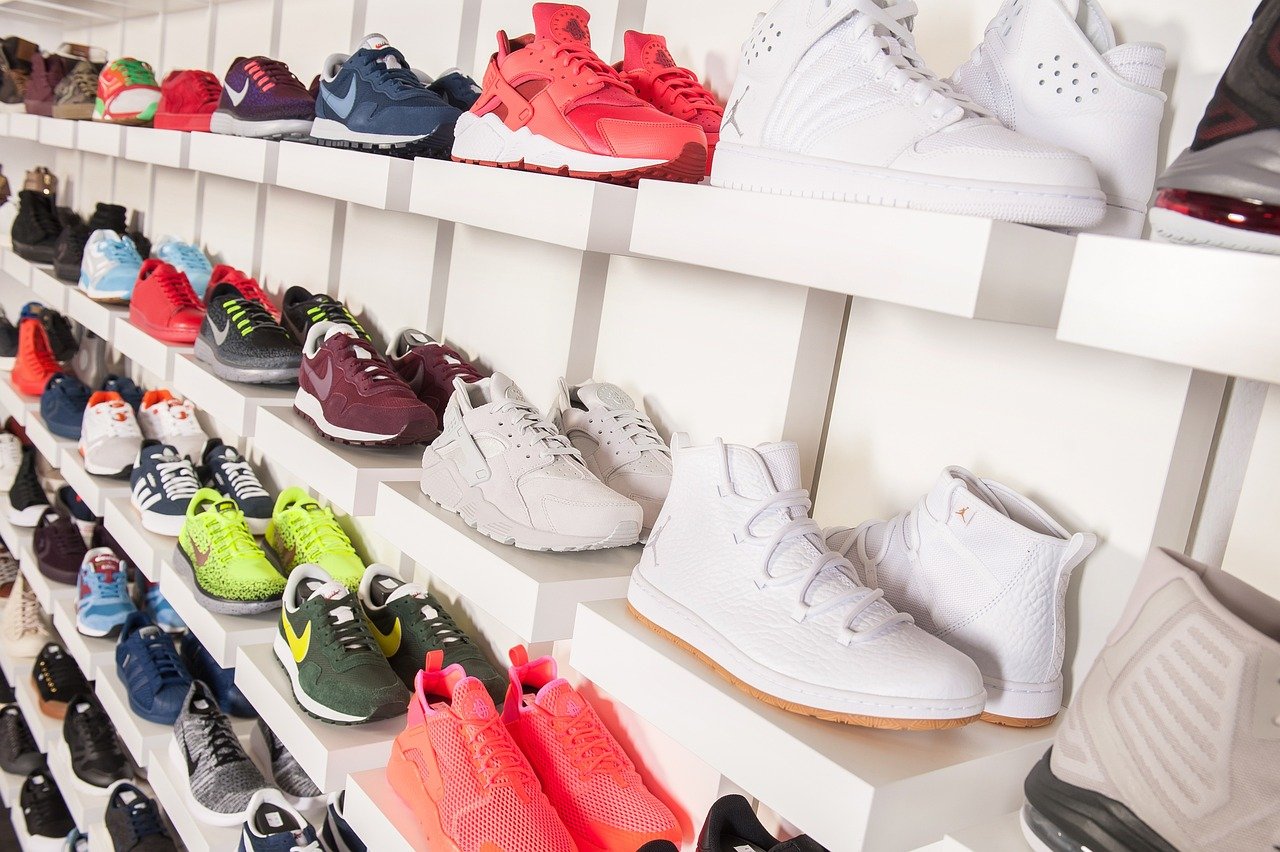
Korean shoes are labelled in millimetres, which sounds intimidating and is actually the most sensible system anyone uses. 250 means the shoe fits a 250mm foot. That is it. No secret conversion, no half sizes to argue about.
The problem is the range. Women’s shops commonly run 225 to 250, and men’s shops 250 to 280. If your foot is longer than that, small shops simply will not have it, and asking will get you a polite and genuinely apologetic no. Department stores and the international sports brands go further, and that is where to head first rather than last.
If you do not know your foot length in millimetres, stand on a piece of paper with your heel to a wall, mark the end of your longest toe, and measure. Round up 5mm if you land between sizes. Do this before you fly, not in a shop while three people wait behind you.
Buying online: the centimetre chart is your friend
Every Korean shopping listing includes a measurement table, and it is far more useful than the size label above it. Four words cover almost all of it:
총장 is total length, top of the garment to the hem. 어깨 is shoulder, seam to seam across the back. 가슴 is chest, measured flat across and then doubled. 소매 is sleeve length.
Here is the trick that makes this work. Take something you already own that fits you well, lay it flat on a table, and measure those four numbers. Write them down. From then on you are not guessing at Korean sizes at all, you are comparing centimetres to centimetres, and the label on the tag stops mattering. This is what Koreans actually do, and it is why the free size thing bothers us less than it bothers visitors.
Three things worth being able to say
이거 프리사이즈예요? — i-geo peu-ri-sa-i-jeu-ye-yo? — Is this free size? Ask it first and you will save yourself the fitting room.
더 큰 거 있어요? — deo keun geo iss-eo-yo? — Do you have a bigger one?
입어봐도 돼요? — ib-eo-bwa-do dwae-yo? — Can I try it on? Fitting rooms exist almost everywhere, including the stalls at Dongdaemun, and staff expect the question.
If you want more of these, I wrote out the phrases that actually come up in shops, restaurants, cafes, and taxis.
One last thing, and I mean this
The label is a manufacturing decision, not a verdict. Korean clothing is cut for the median Korean body because that is who buys most of it, and the industry has been slow to widen that, which is a fair criticism of the industry rather than a fact about you. Plenty of Koreans do not fit Korean sizing either. That is exactly why 빅사이즈 is a category with its own shops.
Go up a size, start at the department stores or the chains, ask about free size before you commit, and carry your four measurements in centimetres. Do that and shopping here goes from demoralising to genuinely good, because the actual clothes are excellent and the prices are better than most people expect.
Speaking of which, if the number on the price tag is the next thing throwing you, the sale signs here have their own logic. I put together a sale price calculator that works out what you are really paying, in won and in your own currency. And if you want to know whether Myeongdong is still where you should be doing any of this, I had a fairly honest look at that recently.