Here is the block, and you should read it twice because it doesn’t sound real. A Buddhist temple founded in 794 sits on one side of the road. Across from it: several floors of mall with a luxury wing, an aquarium in the basement, a casino, a cinema, a convention centre big enough to host a summit, a tower still called the City Air Terminal, and the single most photographed bookshelf in South Korea.
All of that is within about ten minutes’ walking, most of it without going outside. And the strangest part isn’t that the pieces exist. It’s that nobody in Seoul finds the combination odd.
Nothing in this block agrees with anything else
I’m not a mall person. I’d normally walk past COEX without a second thought, and for years I did. What changed my mind wasn’t the shopping, it was realising that the temple came first — by about twelve hundred years.
Bongeunsa’s own history page mentions something most visitors never hear: the national examinations that qualified Buddhist monks were held on the ground where COEX now stands. The area had a name for it, Seunggwapyeong. Monks who became some of the most important figures in Korean Buddhism were tested on that field. The field is now a convention centre with a food court under it.
That’s Gangnam in one sentence, really. Not the K-pop video version, not the plastic surgery clinics on Apgujeong-ro. Just the ordinary Seoul habit of building whatever is needed next, directly on top of whatever was there, and then not being weird about it. Nobody here experiences the temple and the mall as a contrast. They’re both simply places you might go on a Saturday.
The Starfield Library is not a library
Let’s clear this up first, because the English name misleads people constantly. You cannot borrow anything. There’s no membership, no checkout desk, no reading room silence. It is a mall atrium with enormous shelves in it, open to anybody walking past, and treating it as a library is the fastest way to be disappointed by it.
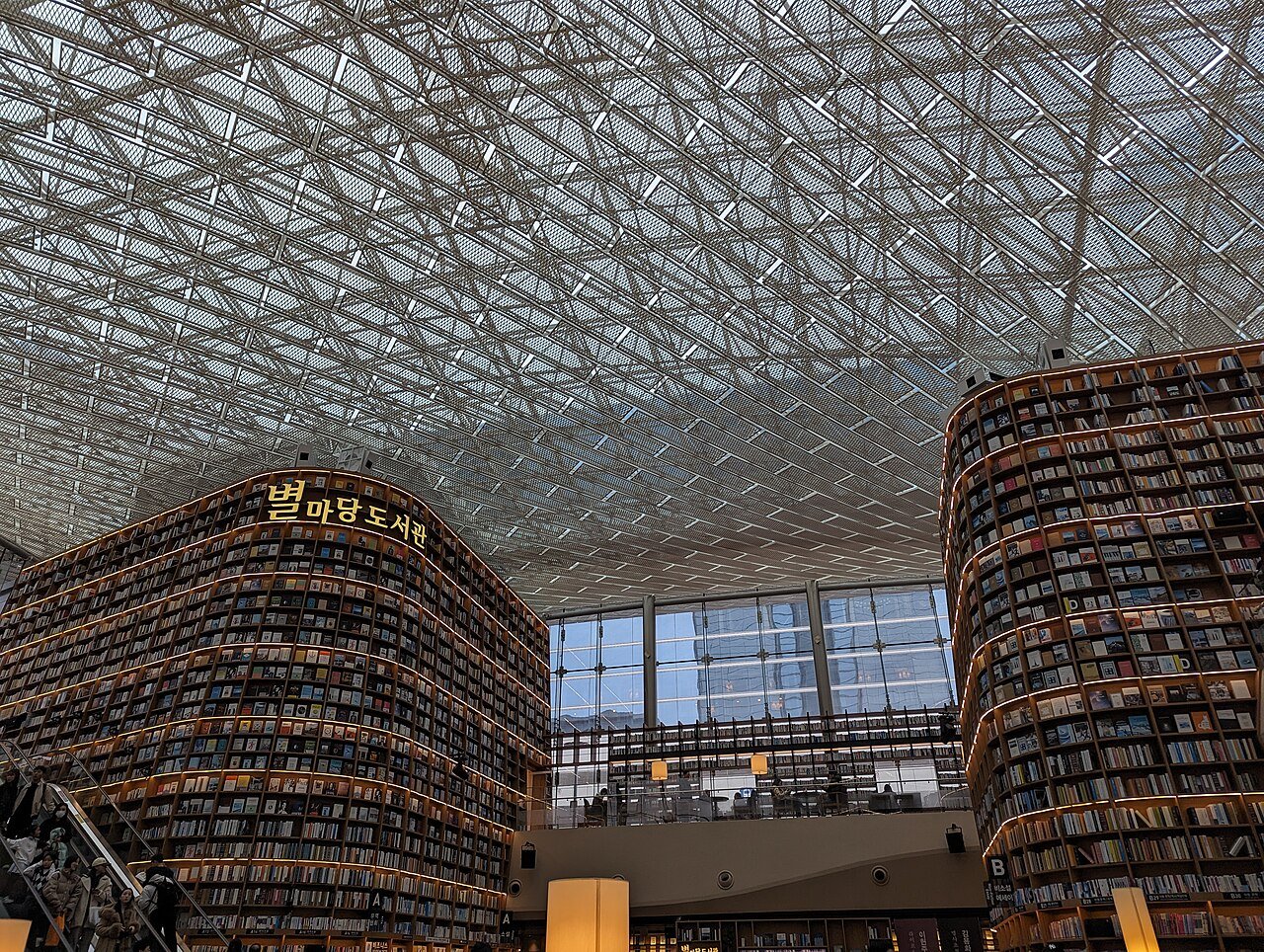
Treated as what it actually is — a room — it’s genuinely impressive. Two curved shelf towers rise the full height of the atrium, lit from within, with a mesh ceiling above that throws grid shadows across everything by mid-afternoon. There are proper tables at the base, and people sit at them for hours: students with laptops, a man asleep behind a newspaper, teenagers who have clearly been there since lunch. Escalators run up both sides, which is the source of about ninety percent of the photographs taken here, because everyone works out within a minute that the good angle is from halfway up.
What surprises first-timers is the noise. It’s a shopping mall: announcements, kids, an espresso machine somewhere. If you arrive picturing a hushed cathedral of books you’ll spend five minutes being quietly annoyed before you adjust. The people who enjoy it most are the ones who show up expecting a big handsome room and get exactly that.
The shelves reach well past arm’s height and the upper sections are decorative rather than browsable — nobody is climbing up there to pull down a paperback, and the ladders are staff equipment, not a photo prop. I’m not going to repeat the story that circulates in English about what’s in the top rows, because I’ve never seen anyone from the mall confirm it. What I can tell you is the part that matters to you: reach what you can reach, read it in a chair, put it back.
It’s free and it sits inside the mall’s hours, which Starfield lists as 10:30 to 22:00. Weekday mornings the place is calm and the tables are yours. Weekend afternoons it’s a queue of people taking the same shot, and the escalator angle has a small crowd waiting their turn on it.
Bongeunsa: four minutes and twelve centuries away
Cross Bongeunsa-ro and the volume drops. That’s not a figure of speech — the traffic noise falls off inside the first gate, then the pines take the rest, and by the time you’re up the steps you can hear your own footsteps on stone. Four minutes earlier you were looking at a Zara window.
The official numbers, from the temple’s own directions page: 600 metres from Samseong Station exit 6 on Line 2, or 100 metres from Bongeunsa Station exit 1 on Line 9. That second one is worth remembering. Line 9 opened later, and the exit puts you practically at the gate.
What you actually walk into: a working temple, not a preserved ruin. There are people here doing something rather than looking at something. Someone bows three times at the main hall and leaves without breaking stride on the way to work. Somebody else is on their knees for a very long time. Monks cross the courtyard without looking at anyone. It’s a Tuesday, and this is just what happens on a Tuesday.
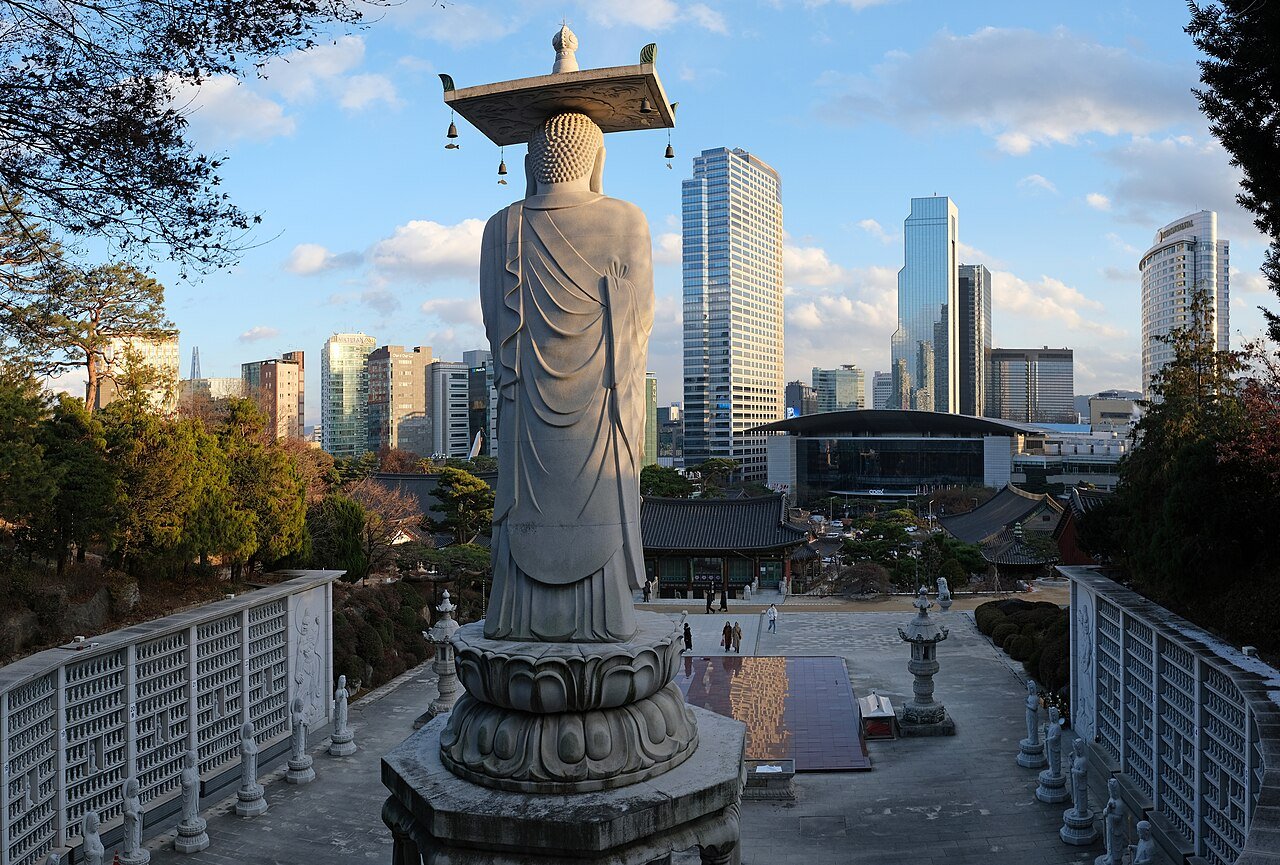
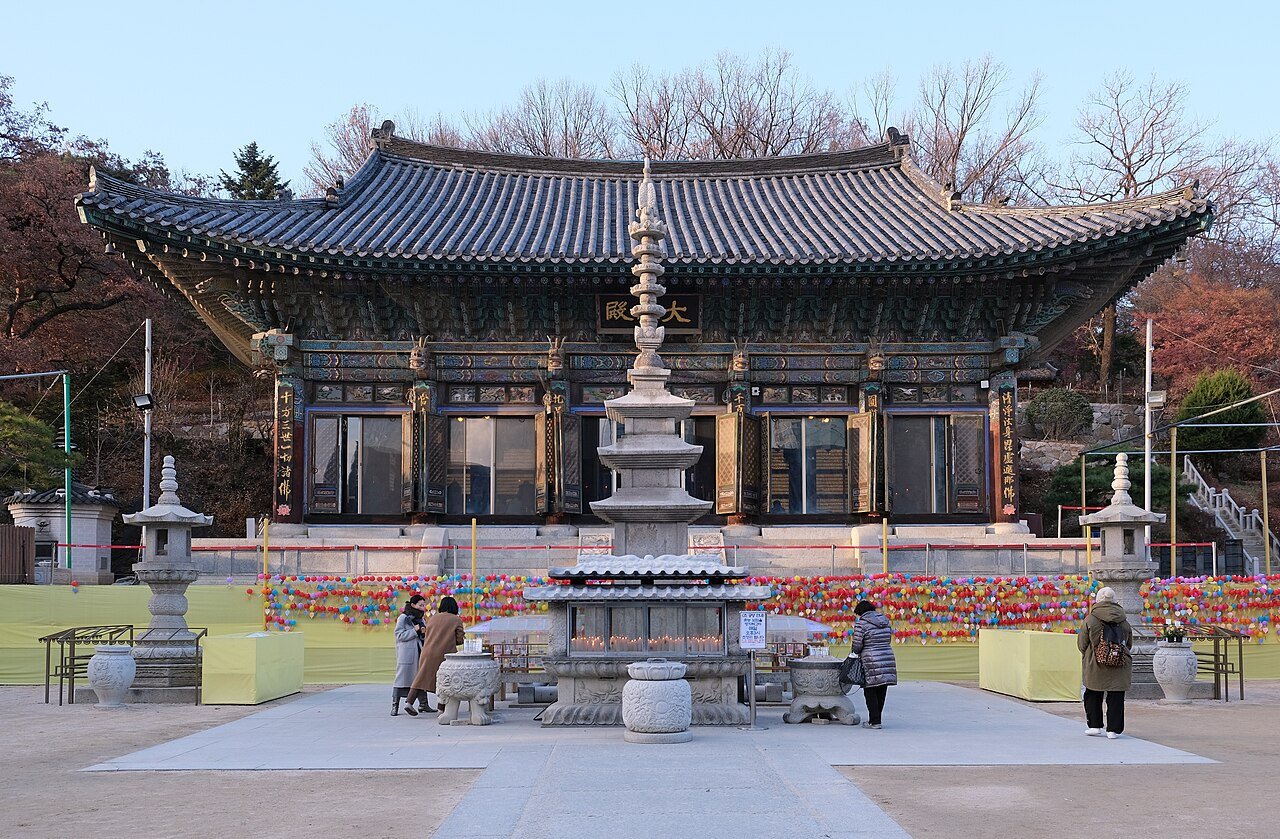
The main hall, Daeungjeon, sits at the top of the steps with candles and incense in front of it, and in spring the whole courtyard fills with paper lanterns strung in rows for Buddha’s Birthday — thousands of them, each with somebody’s name and wish on a slip underneath. The photograph everybody takes, though, is the stone Buddha up the hill: a giant standing Maitreya with the Gangnam skyscrapers directly behind its shoulder, the convention centre roof visible between the trees. You don’t have to arrange that shot. You just turn around.
The building I’d point you to instead is Panjeon, the smaller hall off to the side, because almost nobody stops there. It holds 81 woodblocks of the Avatamsaka Sutra, carved in the late Joseon period. The wooden board above the door was written by Kim Jeong-hui — Chusa, the calligrapher whose style Koreans still study — and the temple says it was his last work, finished in his final years. A mall car park sits a few hundred metres away and that board has been hanging there since the 1850s.
Nobody charges you at the gate, nobody hands you a ticket, and in all the times I’ve walked in I’ve never been asked for anything. Wear whatever you like within reason, take your shoes off if you go inside a hall, don’t photograph people praying, and step to the side rather than through if somebody is bowing. That’s the whole etiquette.
If you want more than a walk-through, Bongeunsa runs one of the better-known templestay programmes in Seoul, and it’s set up for foreigners — the official templestay listing carries an English application route. There’s a day version that runs roughly 10:00 to 16:00, a Thursday temple tour with tea, and an overnight Saturday-to-Sunday programme. The overnight one is not a hotel with a view: the temple’s own schedule has you arriving at 14:00, at evening chanting by 17:00, lights out at 21:30, awake at 04:00, and doing 108 prostrations before five in the morning. People come out of it changed or wrecked, sometimes both. Either way, it’s a strange and excellent thing to do in the middle of a city of ten million.
You will get lost. Koreans get lost here too
This is not a you problem. COEX was built in pieces over decades, renovated in sections, and the result is a mall with no single spine and several places where the level you’re on stops being the level you thought you were on. I have walked confidently in the wrong direction here more times than I’d like to write down.
What locals do is ignore the map and navigate by landmarks. Nobody says “B1, section C”. They say “meet me at the library” or “by the aquarium entrance” or “the cinema side”, and everyone finds each other. The library is the anchor everybody uses because it’s in the middle and impossible to mistake for anything else. If you’re meeting someone, name it as the meeting point and stop trying to be more precise.
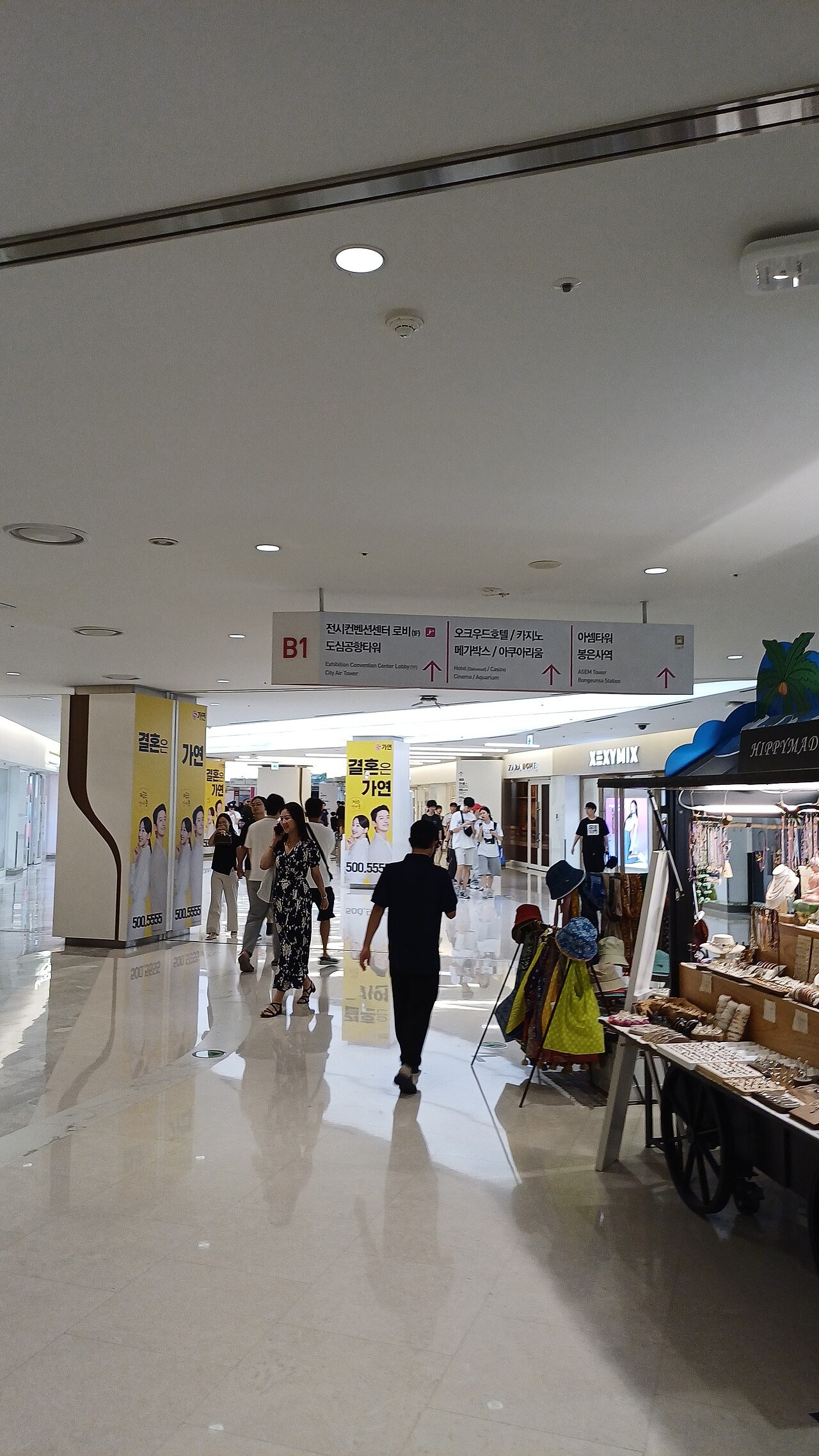
The other trick is to read the overhead signs rather than looking for shop numbers. They’re bilingual, and they point at destinations rather than zones — the convention centre lobby that way, the cinema and aquarium that way, Bongeunsa Station and the ASEM tower the other way. Follow the destination you want and let the mall unfold around you. You’ll still overshoot once. Everyone does, and there’s a coffee shop wherever you end up.
Samseong or Bongeunsa Station, and why “Gangnam” isn’t Gangnam Station
Two stations serve this block and they’re not interchangeable. Samseong Station is Line 2, and exits 5 and 6 lead into the mall without you ever meeting a crosswalk — which matters in August, when Seoul’s humidity turns a two-minute walk into a decision. Bongeunsa Station is Line 9, and its exit 1 is the temple one.
So: coming for the mall, take Line 2 to Samseong. Coming mainly for the temple, take Line 9 to Bongeunsa. Doing both, either works, and the underground passages mean you can arrive at one and leave from the other without going outside.
And now the mistake I see most often in English-language plans. Gangnam is not Gangnam Station. Gangnam-gu is a district roughly the size of a small city, and Gangnam Station sits about three kilometres west of here, a different neighbourhood with a different personality — louder, younger, more street-level, full of exam academies and chain restaurants. The COEX end of Gangnam is corporate, wide-avenued, and comparatively quiet on a Sunday. Visitors book a hotel “in Gangnam” expecting one and get the other, then spend a week on Line 2 wondering why nothing matches the photos. Both are Gangnam. They just have nothing in common.
The airport terminal that stopped being one
The B1 signs still point to the City Air Terminal tower, and the tower is still there, and people still arrive expecting to check in for a flight and hand over their suitcase here. Here’s the current picture, because this one has changed and a lot of guides haven’t caught up.
I checked the operator’s own site in September 2026. It advertises limousine buses to Incheon and Gimpo — including route 6103 running from COEX to Incheon Airport — plus a luggage-forwarding add-on, and nothing else. There is no airline check-in listed, no baggage drop, no immigration counter, and no list of participating airlines anywhere on the Korean or English site. Those services are simply not on offer there today.
So plan on checking in at the airport, and treat the terminal as what it currently is: a good place to catch a bus, from a building with an obsolete name. If someone’s guidebook tells you to check your bags in Samseong-dong and spend the afternoon shopping, that guidebook is out of date — confirm with your airline before you build a day around it.
There is still a city terminal that does the real thing, though, and if dropping your luggage early was the appeal, this is where to do it: Seoul Station. Incheon Airport’s own city-terminal page lists check-in, baggage drop and immigration on the second basement level of the airport-railroad station, with check-in and bags running 05:20 to 19:00 and immigration 05:30 to 19:00 — cut off three hours before a Terminal 1 departure, three hours twenty before Terminal 2. The conditions matter more than the hours. It’s for same-day international departures out of Incheon only, it’s for express-train passengers only, and which airlines each terminal can check you in for differs, so confirm yours with that terminal rather than assuming. Get it right and you arrive at Incheon with empty hands and walk in through the dedicated departure corridor on level 3. (Gwangmyeong Station has one too, 06:30 to 17:00, though immigration there hasn’t resumed since Covid and now happens at the airport.) All of that checked on 11 September 2026 — times like these move, so look before you rely on them.
And the detail that really settles the COEX question: the airport’s official list of city terminals has exactly two entries, Seoul Station and Gwangmyeong. COEX isn’t on it at all. That’s better evidence than anything the operator’s own website does or doesn’t advertise.
The aquarium, in one paragraph
Yes, there’s an aquarium in the basement, and it’s a real one rather than a few tanks in a corridor. Whether it’s the aquarium you should pick — there’s a bigger, newer one under Lotte World Tower a few subway stops away — is an argument I’ve already had at length in the Lotte World Aquarium post, which compares the two. Short version: go to whichever is closer to where you’re already standing, and don’t do both.
How I’d actually spend the afternoon
Arrive at Samseong on Line 2 in the late morning, when the library has empty tables. Walk the mall for an hour without trying to see all of it. Eat something unremarkable but cheap, because this is a mall and mall food is mall food everywhere on earth. Then cross to Bongeunsa around four, when the light goes gold on the stone Buddha and the evening chanting is coming up, and stay until you notice you’ve stopped checking your phone.
Leave from Bongeunsa Station on Line 9 with a transit card — if you haven’t sorted one, the T-money post covers where to buy and how to get the deposit back. And if you’re carrying luggage because this is your last day, the station lockers are the move; sizes and prices are in the luggage storage post.
One block. A temple older than most European cathedrals, a bookshelf that exists to be photographed, sharks under the floor, and a tower named after a service it no longer provides. I’ve stopped finding it strange, which is probably the most Seoul thing about me.