Standing on a curb with your arm out doesn’t really work in Korea anymore, not in any city with real traffic. Drivers are staring at their phones, picking up ride requests through an app called Kakao T, and half the time they’ll cruise right past you like you’re invisible. If you want a taxi here in any reasonable amount of time, you need the app too.
What Kakao T actually is
Kakao T (카카오 T) is Korea’s dominant ride-hailing app, built by the same company behind KakaoTalk, the messenger everyone here uses instead of texting. It’s not a separate taxi company on its own — it’s a booking layer sitting on top of the existing licensed taxi fleet. So when you order a ride, you’re getting a real metered taxi, just summoned through your phone instead of your arm.
Sit in the front seat once and you’ll see why the arm-waving stopped working. The phone mounted on the dashboard lights up with requests every few seconds — destination, distance, fare — and the driver takes or ignores each one with a thumb, sometimes mid-conversation. A person standing on the curb isn’t competing with other people on the curb. They’re competing with a screen that already knows where everyone wants to go.
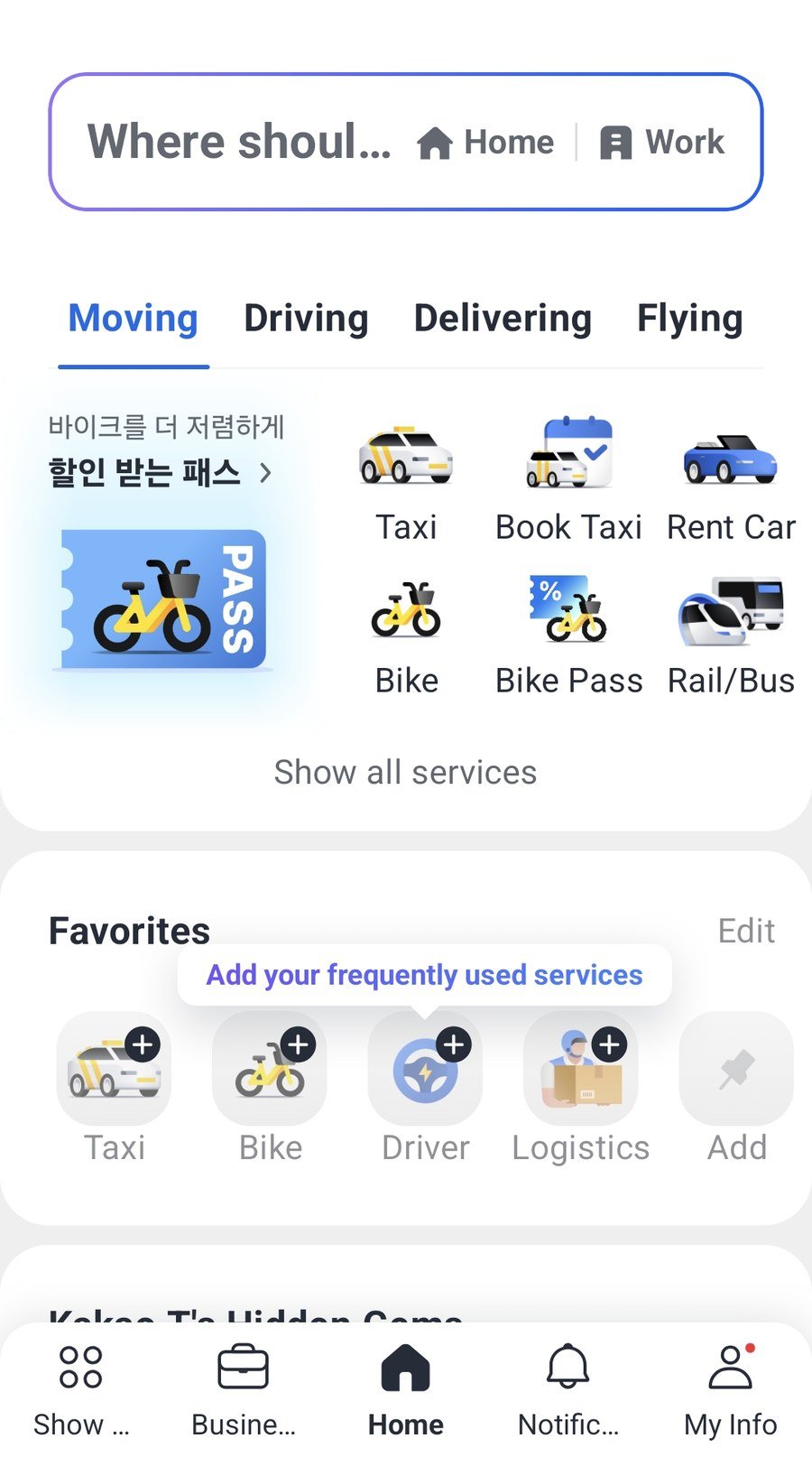
The app added a proper English interface a few years back for exactly this reason — too many tourists were getting stuck at the Korean-only version. Tap My Info in the bottom tab bar, find the language option in there, and switch it before you actually need the app, not while you’re standing in an arrivals hall trying to decode menus. Even once it’s set to English, a few odds and ends stay in Korean anyway, a promo banner here, a badge there, so don’t panic if something on screen still looks unreadable.
This is what the home screen looks like once that’s done. Under the Moving tab you’ll see Taxi, Book Taxi, Rent Car, Bike, Bike Pass, and Rail/Bus laid out as icons, with Driving, Delivering, and Flying sitting as separate tabs up top that most tourists never need to touch. Taxi is the one you want for a normal ride right now; Book Taxi is for scheduling one ahead of time instead of ordering on the spot.
Setting it up before you actually need it
Here’s the part that trips people up: Kakao T wants a Korean phone number to verify your account, and your home SIM usually won’t receive the code. If you’ve already grabbed a Korean SIM or eSIM for the trip, do the Kakao T signup after that line is active, not before. Trying to register over airport wifi with a foreign number just sits there spinning forever.
Payment is the second snag. You can add a foreign Visa or Mastercard in the app, and it usually goes through, but “usually” is doing some work in that sentence — I’ve had it reject perfectly good cards for no visible reason more than once. Cash still works as a fallback; you just pay the driver directly and the app handled the booking and routing part.
If you’re landing and setting all of this up at the airport, do it in the right order: SIM counter first, then the app, then the card. The verification code goes to the Korean number, so the account simply can’t be finished before that line is live. It’s also worth doing it while you’re still standing near the counter rather than on the train into the city — if the code doesn’t arrive, the person who just sold you the SIM is the fastest way to find out why.
Ordering a ride
Open the app, drop a pin on your location (or let it find you, which works fine most of the time), and type in your destination. This is where things get annoying if you don’t read Korean — a lot of smaller addresses and building names don’t come up well in English search. My workaround is searching for a well-known landmark or a big chain store near where I’m actually headed, then walking the last few minutes. Hotels and major attractions are usually easy to find directly.
The trick that actually solves the address problem is pasting rather than typing. Korean addresses come in two systems — the older lot-based one and the newer road-name one — and the app searches Korean text, not your transliteration of it. Your hotel’s confirmation, or its page on the booking site, has the address written in Korean somewhere on it. Copy that block, paste it into the destination field, and the building comes up on the first try. You never have to read a character of it.
You get a fare estimate before you confirm anything, which honestly beats the old system of just hoping the meter was running fair. Standard sedan taxis are what you’ll use almost every time. There’s also a black premium tier with nicer cars and drivers who tend to speak a little more English, for maybe 30 to 40 percent more than standard fare.
Kakao T Venti — the one people don’t expect
If there are four of you traveling with real luggage, look for Venti in the vehicle options. It’s a large van, and it exists specifically because regular taxis here are small sedans that fit maybe two suitcases if everyone’s polite about it. Venti costs more, noticeably more during surge pricing, but it’s saved me from the awkward routine of trying to wedge a roller bag into a trunk that clearly wasn’t built for it.
When Venti doesn’t come, and on a busy evening it sometimes doesn’t, the move is to stop waiting and order two regular taxis instead. Four people and four bags split across two sedans gets you moving, and during surge it can land close to what the one van would have cost anyway. Send the same destination to both and the second driver will simply follow the first. I’ve done this outside Seoul Station with a group and we were rolling before the Venti request had found anyone.
The stuff nobody warns you about
Drivers sometimes call before they arrive, and it’s always in Korean. Don’t panic — they’re usually just confirming they see you, or asking exactly where you’re standing if the pin dropped near a busy intersection. You can let the call go and they’ll generally still show up, but if you’d rather skip it entirely, there’s a text message option in the app you can use instead.
Late at night is when the app actually earns its keep, and also when it’s most likely to fail you. Between roughly 11pm and 1am on weekends, especially near nightlife areas, demand spikes hard and you’ll sit there watching “searching for driver” for ten minutes with nothing happening. Locals just know this and either order early, walk toward a slightly quieter street first, or accept the surge multiplier. There’s no real trick around it — it’s just what a Friday night looks like in a city this size.
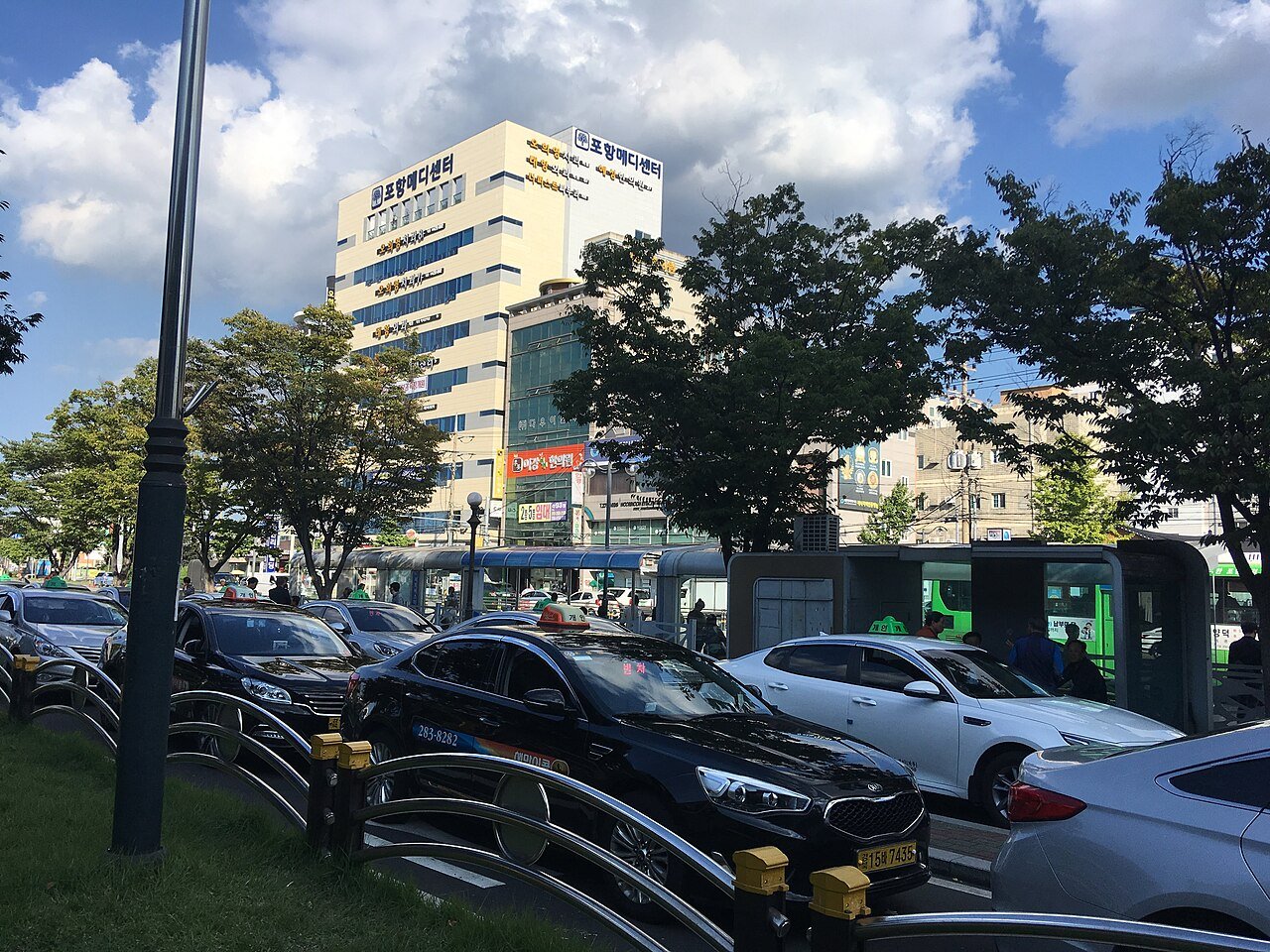
One habit worth building: read the plate number off the app before you open a door. In a busy pickup spot several taxis nose into the same twenty meters of curb within a minute of each other, and getting into the wrong one is an easy mistake to make in the dark. The plate is right there on the ride card. It also matters afterward — because the ride is logged in the app, a bag left on the back seat has a paper trail attached to it from the moment you got in.
Kakao T vs. Uber
Uber does operate in Korea, but not the way it works back home — it’s essentially plugged into the same taxi network Kakao T uses, so you’re not tapping into some separate fleet of private drivers. If you already have Uber installed and don’t want to bother with another app, it’ll get you around just fine. I still default to Kakao T because the driver pool is bigger and pickup times are consistently shorter, but if a familiar interface matters more to you than shaving a few minutes off the wait, Uber’s not a bad call either.
There’s one situation where Uber is clearly the easier answer, and it’s the two problems from earlier in this post: the account you already have from home works here as it is. No Korean number to verify, no card to talk into being accepted. If you land without a SIM sorted out and need to get somewhere that night, that’s the app that will actually take your money. Just set your expectations first. Uber here is not the private car you ride at home — it summons a licensed taxi, and until a couple of years ago it went by an entirely different name, UT.
Either way, skip the arm-waving. It wasn’t really working before you got here, and it’s working even less now.
Read next
- T-Money Card in Korea: Where to Buy It, Where to Use It, and How to Get a Refund — Cheaper, for everything that isn’t a taxi.
- SIM Card or eSIM in Korea? Airport Pickup vs. Telecom Store, Compared Honestly — None of this works without data.
- Survival Korean: What to Say at Restaurants, Shops, Cafes, and in a Taxi — What to say if the driver calls.